Loading blog posts...
April 25, 2026 • 3 min read
Navigating a cyclical downturn in the global chemical industry requires a steady hand, and materials science giant Dow Inc. is facing this challenge head-on. The company's first-quarter 2026 10-Q filing reveals a story of top-line pressure from a sluggish market, but also a determined effort to manage costs and streamline operations. Let's explore the key figures to understand how Dow is navigating this tough environment.
Dow reported net sales of $9.8 billion for the first quarter of 2026, a 6% decrease from the $10.4 billion generated in the same period last year. This decline was primarily driven by a 7% drop in local prices and a 2% dip in volume, which were only partially offset by a 3% favorable currency impact.
A look at Dow's operating segments shows this pressure was broad-based:
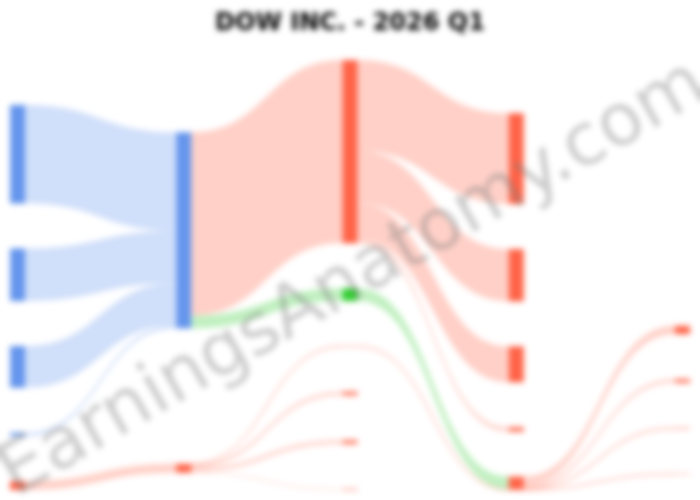
To understand how revenue translated to the bottom line, we can visualize the flow of income and expenses. The diagram below illustrates how the $9.8 billion in sales was allocated across various costs, ultimately leading to a net loss for the quarter.
The "Corporate" revenue slice of $169 million seen in the diagram primarily represents business activities and sales that are not allocated to the main operating segments. While cost of sales decreased to $9.15 billion from $9.76 billion year-over-year, reflecting some cost control, it wasn't enough to offset the revenue decline and other rising expenses.
A particularly significant factor was the $303 million in losses from nonconsolidated affiliates, a dramatic increase from just a $20 million loss in the prior year. This item alone played a major role in pushing the company into the red. Consequently, Dow posted a net loss of $445 million, a wider gap compared to the $290 million loss in Q1 2025. The net loss available to common stockholders came in at $533 million, or ($0.74) per share.
In response to the challenging market, Dow is continuing its strategic cost-saving initiatives. The filing details the ongoing "2025 Restructuring Program," aimed at optimizing the company's cost structure. While the company recorded a relatively modest $27 million in restructuring and asset-related charges this quarter, it follows a period of more significant charges, indicating a continued commitment to creating a leaner organization prepared for the eventual market rebound.
In conclusion, Dow's first-quarter results paint a clear picture of a company navigating a cyclical trough. While external market weakness is pressuring sales and profitability, Dow's management is proactively addressing its cost base. The sharp increase in losses from equity affiliates was a significant headwind this quarter, highlighting the complex, interconnected nature of its global operations. The company's path forward will depend heavily on a recovery in global industrial demand and the success of its ongoing efficiency programs.
Last updated: April 25, 2026