Loading blog posts...
July 24, 2026 • 4 min read
Dover Corporation is one of those quietly essential industrial names that most people have never heard of, yet whose products touch everything from fuel pumps at your local gas station to the marking systems that stamp expiration dates on your groceries. The Downers Grove, Illinois-based diversified manufacturer operates across five segments and competes with the likes of Emerson, Illinois Tool Works, and Roper Technologies. Let's dig into the numbers from Dover's second-quarter 2026 10-Q filing to see how the business is tracking and what the segment-level detail reveals.
Dover generated $2.19 billion in revenue for the quarter ended June 30, 2026, up 6.9% from $2.05 billion a year earlier. Management attributes 4.8% of that growth to organic gains (growth excluding acquisitions and currency swings) spread across all five segments—an encouragingly broad-based result.
The profitability picture improved right down the income statement:
Notably, EPS growth outpaced net income growth, helped by Dover's ongoing share buybacks. Weighted average diluted shares fell to 135.6 million from 138.0 million a year ago, as the company repurchased stock (153,652 shares at an average of $200.99 in April) and still has over 14 million shares authorized for future repurchase.
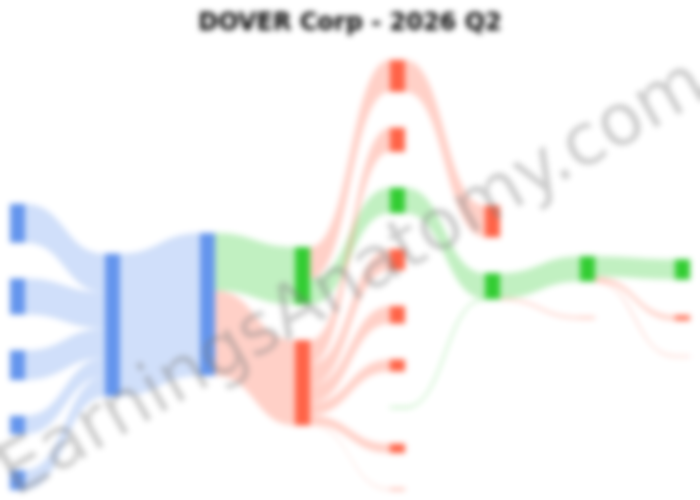
The flow of revenue into costs, expenses, and ultimately profit is laid out below:
Digging into the segments tells a more interesting story than the headline numbers alone:
That Climate & Sustainability margin dip is worth watching, but the more compelling data point is bookings—forward-looking order intake. Climate & Sustainability bookings soared 45.8% to $560 million, a signal that the current margin softness may be a temporary function of mix and ramp-up costs ahead of a demand wave. This segment's exposure to CO₂ cooling and data-center thermal management positions it in some genuinely secular growth markets.
Dover's financial position looks sturdy. Six-month operating cash flow reached $427 million (up from $370 million), and free cash flow grew to $320 million. The company's net-debt-to-net-capitalization ratio improved to 16.3% from 18.2%, aided by a $1.76 billion cash pile. Restructuring charges did climb meaningfully—$47.2 million for the half-year versus $21.8 million a year ago—as Dover pursues headcount reductions and facility consolidations, a cost investors will want to see convert into future margin gains.
Dover delivered a clean, broad-based quarter: organic growth across every segment, expanding margins, and double-digit EPS growth. The standout narrative is the 45.8% booking surge in Climate & Sustainability Technologies, which suggests the near-term margin dip there is a setup for stronger volume ahead. With a fortified balance sheet and rising free cash flow, Dover appears well-positioned—though elevated restructuring spending and the Climate segment's profitability will be key items to monitor. For a sprawling industrial conglomerate competing against ITW and Roper, executing this consistently across five distinct businesses is no small feat.
Last updated: July 24, 2026
Explore prior quarterly filings, historical revenue breakdowns, and earnings trends.