Loading blog posts...
April 1, 2026 • 4 min read
If you’ve recently filled up your car, bought a frozen meal at a supermarket, or noticed a date code printed on a package, you have likely interacted with Dover Corporation (DOV). A diversified global manufacturer, Dover operates a vast portfolio of specialized industrial products.
In their latest 10-K filing for the fiscal year ended December 31, 2025, Dover reported a year of distinct operational improvement, even though a quick glance at the bottom-line net earnings might suggest otherwise. The company posted full-year revenue of $8.09 billion, a 4.5% increase over the previous year, while notably expanding its gross margins.
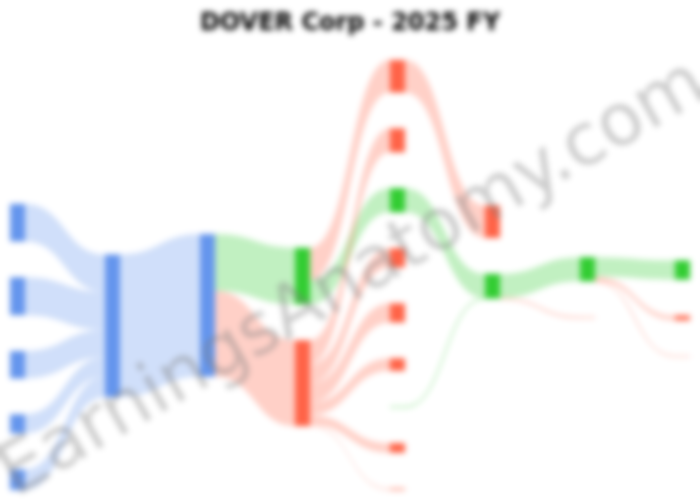
To visualize how Dover converts its industrial sales into profit, take a look at the income statement flow below:
The most startling figure in the filing is the decline in Net Earnings, which fell from $2.70 billion in 2024 to $1.09 billion in 2025. For an investor just skimming the surface, a 59% drop in profits looks alarming. However, this variance is largely due to portfolio restructuring rather than operational weakness.
The 2024 results were heavily skewed by Discontinued Operations—specifically the sale of the Environmental Solutions Group—which contributed nearly $1.3 billion to that year's net earnings. Additionally, 2024 included a significant gain on dispositions of nearly $600 million. 2025 was a "cleaner" year focused on continuing operations. When we strip away the noise and look at Operating Earnings (profit from core business operations), Dover actually improved by 13.8%, rising to $1.37 billion.
A standout metric in this report is the Gross Profit Margin, which expanded by 160 basis points to 39.8%. In the industrial sector, expanding gross margins to nearly 40% is a strong indicator of pricing power—the ability to pass costs on to customers—and improved operational efficiency.
Despite an increase in Selling, General, and Administrative (SG&A) expenses, the company managed to keep these costs relatively flat as a percentage of revenue (22.8%). This allowed the gross margin expansion to flow efficiently down to the operating line.
Dover’s conglomerate model allows for a clear view of different industrial cycles. Here is how the key segments performed:
Dover remains a robust cash generator. Cash flow from operating activities rose to $1.34 billion, up significantly from $1.09 billion in 2024. The company deployed this capital aggressively, spending $663 million on acquisitions to bolster high-growth areas and returning $540 million to shareholders through share repurchases.
Dover’s 2025 10-K describes a company that has successfully reset its baseline. While the absence of the massive one-time gains seen in 2024 makes the year-over-year net income comparison look unfavorable, the core operations are healthier, with higher revenues and wider margins.
The company's focus moving forward will likely remain on optimizing its portfolio mix. Specifically, they face the challenge of lifting margins in the Climate & Sustainability Technologies segment, where they face stiff competition from major global players like Panasonic (Hussman Corp.), Alfa Laval, and Danfoss. If Dover can apply the same efficiency levers there that they have used in their Pumps segment, the operational leverage story could continue well into 2026.
Last updated: April 1, 2026
Explore prior quarterly filings, historical revenue breakdowns, and earnings trends.