Loading blog posts...
June 4, 2026 • 4 min read
In this post, the goal is to dig into the income statement of one of the world's largest retailers to see how they are performing in a dynamic macroeconomic environment and what we can learn from their financial results. For those who might be unfamiliar, Costco Wholesale Corporation is a multinational membership-only warehouse club that sells high-quality merchandise in bulk at heavily discounted prices. Their entire business model revolves around keeping merchandise margins razor-thin to pass savings directly to consumers, while making the bulk of their profits through recurring membership fees. Let's unpack the numbers from their latest 10-Q filing for the third quarter of fiscal 2026 to see exactly how this economic engine is running.
During the 12 weeks ended May 10, 2026, Costco delivered total revenue of $70.5 billion, marking a 12% increase from the $63.2 billion reported in the same period last year. Net sales accounted for $69.1 billion of that total, growing nearly 12% year-over-year.
However, the true lifeblood of Costco's profitability is its membership program. Membership fees hit $1.37 billion for the quarter, an 11% jump year-over-year. This reliable growth was driven by new sign-ups, fee increases, and members upgrading to the higher-tier Executive Membership. Costco now boasts a massive 82.9 million paid members and 148.5 million total cardholders globally.
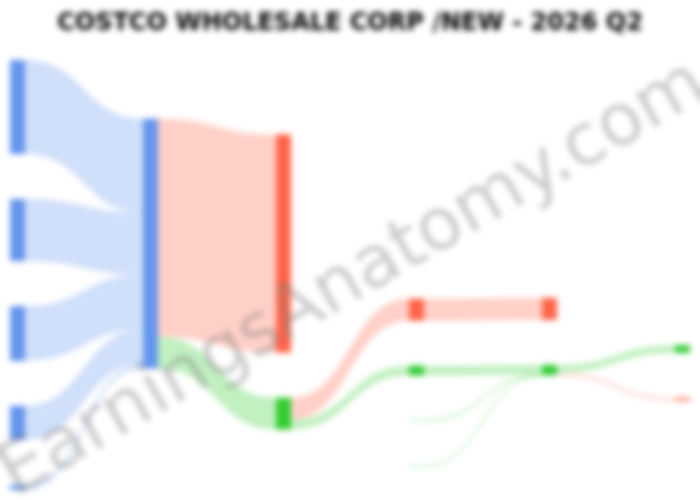
As illustrated in the income statement flow above, Costco pours the vast majority of its incoming revenue right back into the cost of goods sold. Merchandise costs consumed $61.5 billion, leaving a gross margin of $7.6 billion, or about 11.04% of net sales. For most traditional retailers, an 11% gross margin would spell disaster, but for Costco, it is a deliberate, highly successful strategy that builds immense customer loyalty and drives unparalleled inventory turnover.
One of the most fascinating takeaways from this quarter's filing is the outsized impact of gasoline. Higher gas prices at Costco's fuel stations drove a massive $1.37 billion boost to net sales—a positive impact of 221 basis points. The company also benefited from favorable foreign currency exchange rates, which padded net sales by another $643 million. Even when stripping out the volatility of gas prices and currency fluctuations, comparable sales (the benchmark metric for sales at warehouses open for more than a year) still grew by a healthy 7% company-wide.
Costco's legendary operational efficiency was on full display this quarter. Selling, general, and administrative (SG&A) expenses came in at $6.2 billion. As a percentage of net sales, SG&A actually dropped to 8.96% from 9.16% last year. Even when excluding the inflationary impact of gas prices, SG&A as a percentage of sales still decreased by two basis points, proving the company's ability to scale operations efficiently.
Ultimately, these operational controls translated to a very strong bottom line. Operating income reached $2.8 billion, while net income surged to nearly $2.2 billion, or $4.93 per diluted share—a solid 15% increase from the $4.28 per share earned in the third quarter of 2025.
Costco is using its strong cash flow to reward shareholders and reinvest in its footprint. The company declared a quarterly cash dividend of $1.47 per share (up from $1.30 last year) and repurchased 184,000 shares of its common stock for $183 million during the quarter. On the expansion front, Costco opened four new warehouses in Q3 (three in the U.S. and one in Canada) and continues to deploy capital aggressively, having spent $4.2 billion on property and equipment in the first 36 weeks of the year.
Costco continues to be an absolute juggernaut in the discount retail space. While competitors like Walmart's Sam's Club and BJ's Wholesale Club operate on similar warehouse models, Costco's incredible member retention, higher sales volume per warehouse, and expanding international footprint keep it securely at the top of the food chain. This quarter's results show a company that is not just weathering the economic climate, but leveraging its massive scale to widen the moat against its rivals.
Last updated: June 4, 2026
Explore prior quarterly filings, historical revenue breakdowns, and earnings trends.
Costco FY2026: $303B Revenue, 11% Gross Margin, and the Membership Fee Profit Engine
Oct 12, 2026
Read
Costco Q2 2026 Earnings Analysis: Margin Magic & Membership Fees
Mar 12, 2026
Read
Costco Q1 FY2026 Analysis: Membership Fees and Digital Growth
Dec 18, 2025
Read
Costco's 2025 10-K: Analyzing Strong Sales and Membership Growth
Oct 8, 2025
Read