Loading blog posts...
March 12, 2026 • 4 min read
Costco Wholesale Corporation operates a unique and highly lucrative business model. Instead of relying on hefty markups on individual items like traditional grocers, Costco charges customers an annual membership fee in exchange for access to bulk goods sold at razor-thin margins. To see exactly how this strategy is holding up, let's unpack the numbers from their latest 10-Q filing for the fiscal second quarter of 2026 (the 12-week period ended February 15, 2026) and extract some insights from the data.
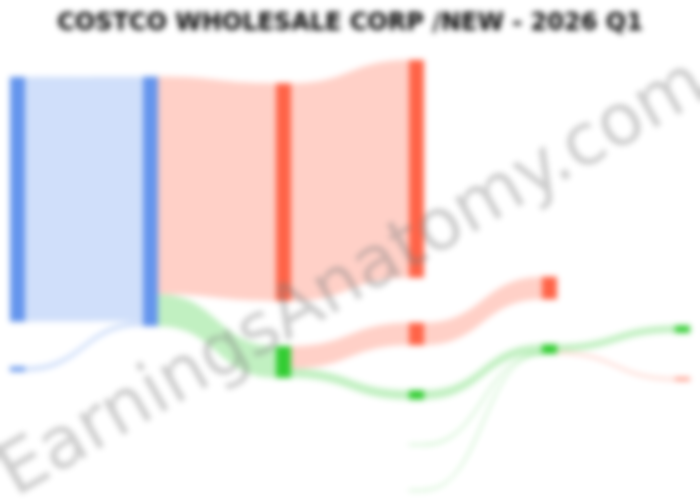
To get a clear picture of how money moves through the warehouse giant—from the cash registers all the way to the bottom line—take a look at this flow diagram mapping out the company's income statement for the quarter:
When you look at Costco's product sales, the sheer volume is staggering, but the margins are deliberately meager. During the second quarter, the company generated $68.2 billion in net sales, pushing total quarterly revenue to $69.6 billion. However, merchandise costs—the direct costs to acquire and sell those goods—came in at $60.7 billion.
This leaves a gross profit margin on net sales of just 11%. This isn't a flaw in Costco's model; it is the core of their strategy. By strictly capping their markups, they ensure members always get compelling deals, which drives the high volume and deep customer loyalty necessary to make their warehouses thrive. Notably, gross margin percentage actually ticked up slightly from 10.85% in Q2 2025 to 11.02% this quarter—a modest but meaningful improvement at Costco's scale.
If product sales barely cover the massive operational overhead—including $6.3 billion in selling, general, and administrative (SG&A) expenses—where does the profit actually come from? The answer is at the front door.
In Q2 2026, Costco collected $1.4 billion in membership fees. This represents a robust 14% year-over-year increase. According to the filing, this jump was driven primarily by new member sign-ups and membership fee increases. Because membership fees carry zero direct merchandise costs, this revenue drops straight down to support the company's $2.6 billion in operating income. The company successfully expanded its base during this period, reporting 82.1 million paid members and a total of 147.2 million cardholders—up from 78.4 million and 140.6 million, respectively, a year ago.
Beyond the physical warehouse aisles, Costco is seeing serious momentum in its e-commerce channel. Digitally-enabled comparable sales surged an impressive 23% during the quarter.
On the physical front, the company continues its steady footprint expansion. Costco opened three net new warehouses (one in the U.S. and two in its Canadian segment) this quarter, bringing the total to 27 net new locations since the end of Q2 2025. This combined omnichannel strength helped push net income to $2.0 billion (or $4.58 per diluted share), a healthy increase from the $1.8 billion ($4.02 per diluted share) reported in the same quarter last year. A lower effective tax rate of 25.2%, down from 26.2% a year ago, also gave the bottom line a modest boost.
The geographical segment data reveals an interesting story. While the U.S. remains the dominant segment at $49.9 billion in revenue, the Other International segment grew the fastest at 15%, followed by Canada at 12%. Both international segments also posted notably higher operating margins than the U.S.—Canada at 5.1% and Other International at 4.8%, compared to the U.S. at 3.3%. This suggests that Costco's international operations are becoming increasingly efficient and profitable, even as the company invests heavily in expanding its domestic footprint. The company also continued to return capital to shareholders, paying a quarterly cash dividend of $1.30 per share and repurchasing $210 million in common stock.
Costco's Q2 2026 results show a company executing its strategy with precision. In a fiercely competitive retail market where big-box stores like Walmart and other warehouse clubs like BJ's and Sam's Club constantly vie for consumer dollars, Costco's intense focus on member value continues to deliver. By successfully growing its paid member base while driving both physical and digital sales—and quietly improving margins along the way—Costco proves that when a retailer consistently delivers tangible savings, shoppers will gladly continue to pay the price of admission.
Last updated: March 12, 2026
Explore prior quarterly filings, historical revenue breakdowns, and earnings trends.
Costco FY2026: $303B Revenue, 11% Gross Margin, and the Membership Fee Profit Engine
Oct 12, 2026
Read
Costco Q3 2026 Financial Analysis: Unpacking the Latest 10-Q Filing
Jun 4, 2026
Read
Costco Q1 FY2026 Analysis: Membership Fees and Digital Growth
Dec 18, 2025
Read
Costco's 2025 10-K: Analyzing Strong Sales and Membership Growth
Oct 8, 2025
Read