Loading blog posts...
October 22, 2026 • 3 min read
Navigating the crosscurrents of cord-cutting, streaming economics, and corporate restructuring, Comcast Corporation's latest financial results offer a revealing look into a media and telecommunications giant in transition. A detailed look at the income statement in Comcast's latest 10-Q filing provides valuable insight into how the company is driving profitability, managing shifting consumer habits, and positioning itself ahead of monumental structural separations.
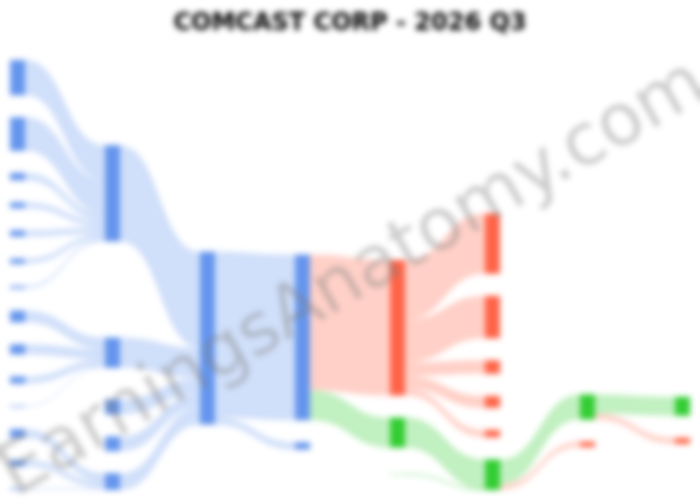
In the visual breakdown above, total consolidated revenue reached $29.30 billion for the third quarter of 2026. The gross sum across operating divisions ($30.59 billion) is reconciled to consolidated revenue via an unallocated net deduction of $1.29 billion, which reflects $355 million in other revenue offset by $1.64 billion in intersegment eliminations.
Comcast’s core telecom business—encompassing Residential Connectivity & Platforms and Business Services Connectivity—generated $19.66 billion in revenue and $7.59 billion in Adjusted EBITDA (earnings before interest, taxes, depreciation, and amortization, a standard gauge of underlying operational cash flow).
The traditional residential business continues to experience customer migration away from legacy bundles. Domestic video revenue contracted 8.7% year-over-year to $5.91 billion as Comcast lost 274,000 video subscribers during the quarter, bringing its video base to 10.39 million. Domestic broadband also faced headwinds, shedding 144,000 customers to settle at 28.34 million, which decreased broadband revenue 4.7% to $6.24 billion.
However, Comcast’s mobile convergence strategy delivered strong momentum:
Revenue at Comcast’s Content & Experiences division rose 6.5% to $10.54 billion. Studios revenue reached $2.97 billion, supported by a 76.6% leap in theatrical revenue to $1.13 billion behind box-office releases. Media revenue expanded 13.0% to $5.36 billion, aided by a 22.4% boost in domestic distribution and major sporting events, pushing Media Adjusted EBITDA up sharply to $769 million from $247 million a year earlier.
Consolidated top-line revenue declined 6.1% compared to Q3 2025 ($31.20 billion), largely due to the completed separation of Versant Media Group in January 2026. Versant—which took over most cable networks including USA Network, CNBC, and Syfy—contributed $1.73 billion in revenue during the third quarter of 2025 but none in 2026.
Despite lower revenue, consolidated operating income dipped only 3.9% to $5.32 billion, while net income attributable to Comcast rose 3.5% to $3.45 billion. Diluted earnings per share (EPS) grew 7.2% to $0.97, bolstered by active share buybacks that lowered the weighted-average share count by 3.5%.
Comcast is executing a profound structural realignment. Following the Versant spinoff, management is preparing for a tax-free spin-off of NBCUniversal and Sky by mid-2027. As telecom rivals like Charter and telecom providers AT&T and Verizon battle over convergence, and streaming titans such as Netflix and Disney pressure linear entertainment, Comcast’s deliberate shift toward broadband infrastructure, wireless expansion, and standalone pure-play operating entities marks a decisive new chapter.
Last updated: October 22, 2026
Explore prior quarterly filings, historical revenue breakdowns, and earnings trends.
Comcast Q2 2026: Broadband Erosion Meets an Olympics-Sized Media Quarter
Jul 28, 2026
Read
Comcast (CMCSA) Q1 2026 Earnings: Versant Separation and Sports Impact
Apr 24, 2026
Read
Comcast 2025 Filing Review: The Hulu Windfall and Wireless Pivot
Feb 4, 2026
Read
Decoding Comcast's Q2 2025: One-Time Gain Masks Shifting Core Business
Aug 1, 2025
Read