Loading blog posts...
February 4, 2026 • 3 min read
Comcast Corporation (NASDAQ: CMCSA) is a conglomerate that sits at the intersection of pipes and content. As the parent company of Xfinity, NBCUniversal, and Sky, it effectively controls both the internet infrastructure that reaches millions of homes and the entertainment that flows through it.
We dug into their latest 10-K filing to dissect the 2025 income statement. While top-line numbers remained stagnant, a massive strategic divestiture significantly altered the profitability landscape for the year.
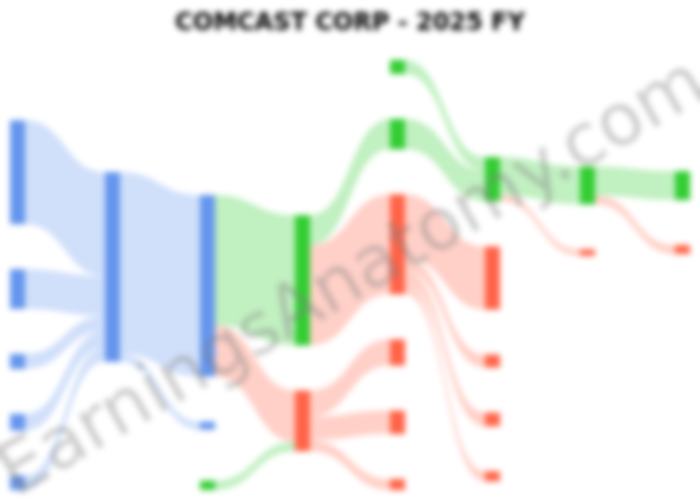
For the fiscal year ended December 31, 2025, Comcast reported consolidated revenue of $123.7 billion, effectively flat compared to 2024. However, the bottom line tells a different story. Net Income attributable to Comcast surged 23.5% to $20.0 billion.
This profit jump wasn't driven by operations, but rather by a significant one-time event: the sale of Comcast's interest in Hulu. In June 2025, the company recognized a pre-tax gain of $9.4 billion from this transaction. Without this infusion, the financial picture looks different, evidenced by Adjusted EBITDA (Earnings Before Interest, Taxes, Depreciation, and Amortization), which actually decreased by 1.8% to $37.4 billion.
To visualize how these revenues and the Hulu gain flow down to the bottom line, take a look at the diagram below:
Comcast’s largest division, Connectivity & Platforms, which includes residential broadband, cable TV, and wireless services (Xfinity Mobile), saw revenue dip slightly by 0.4% to $80.9 billion.
This segment highlights the "cord-cutting" phenomenon reshaping the industry. Video revenue fell 5.1%, driven by a loss of 1.3 million domestic video customers. Consumers continue to abandon traditional cable bundles for streaming alternatives. Furthermore, domestic broadband revenue was flat, signaling saturation in the high-speed internet market.
However, the bright spot remains Domestic Wireless. Revenue here jumped 16.3% to roughly $5.0 billion, adding 1.5 million lines. Comcast is successfully leveraging its broadband footprint to cross-sell mobile services, a critical strategy to offset the decline in legacy cable TV.
The Content & Experiences segment, which houses NBCUniversal’s media networks, film studios, and theme parks, grew revenue by 1.0% to $45.6 billion.
The filing outlines significant risks, primarily the intense competition in the broadband space from fiber and fixed wireless providers, and the continued erosion of the linear television ecosystem.
Comcast is effectively a company in transition. They are managing the slow decline of their legacy cable business while aggressively investing in growth engines like Wireless, Direct-to-Consumer streaming (Peacock), and Theme Parks. While the $9.4 billion Hulu gain provided a stellar net income number for 2025, the core operational challenge remains: replacing the high-margin revenue of traditional cable TV before it evaporates completely.
Last updated: February 4, 2026
Explore prior quarterly filings, historical revenue breakdowns, and earnings trends.
Comcast Q3 2026 Financial Analysis: Wireless Growth, Spinoffs, and Cord-Cutting
Oct 22, 2026
Read
Comcast Q2 2026: Broadband Erosion Meets an Olympics-Sized Media Quarter
Jul 28, 2026
Read
Comcast (CMCSA) Q1 2026 Earnings: Versant Separation and Sports Impact
Apr 24, 2026
Read
Decoding Comcast's Q2 2025: One-Time Gain Masks Shifting Core Business
Aug 1, 2025
Read