Loading blog posts...
July 28, 2026 • 4 min read
Comcast's second quarter of 2026 is the first clean look at the company after it spun off the Versant cable-network portfolio in January — and the first quarter since management announced in June that it will go further and separate NBCUniversal and Sky into a second public company. Digging into the latest 10-Q income statement shows a business whose reported numbers are being reshaped by both portfolio surgery and a once-in-a-cycle sports calendar, while the core broadband engine keeps slowly losing altitude.
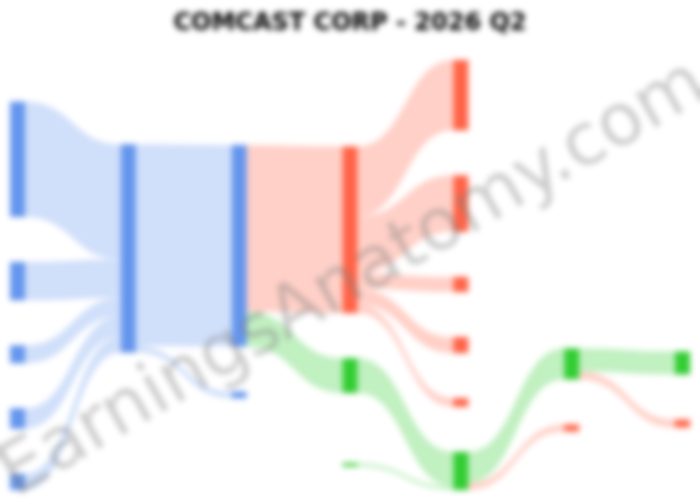
Headline result: revenue of $29.94 billion, down 1.2% year over year, operating income of $5.16 billion (down 13.9%), and net income attributable to Comcast of $3.53 billion, or $0.99 per diluted share versus $2.98 a year ago.
That EPS collapse looks alarming but is almost entirely an accounting echo: the year-ago quarter included a $9.4 billion gain on the sale of Comcast's Hulu stake. Strip that out and pretax income is broadly comparable. Note also the –$999 million "other revenue and intersegment eliminations" line in the flow above: that's $771 million of corporate/other revenue netted against $1.77 billion of intercompany sales (mostly Media and Studios licensing content to Comcast's own distribution platforms), which must be removed to avoid double-counting.
The revenue mix tells the real story. Residential Connectivity & Platforms — broadband, wireless, video and advertising for homes — fell 4.0% to $17.1 billion, with domestic broadband revenue down 5.5% to $6.28 billion and video down 7.8% to $6.09 billion. Comcast lost 167,000 domestic broadband customers and 280,000 video customers in the quarter. Broadband penetration of homes passed slipped to 47.9% from 49.7%, even as the network reached 1.1 million more homes — the plant is growing faster than the customer base.
The offset is wireless: service revenue up 14.2%, equipment revenue up 28.8%, and 448,000 net line additions taking Comcast past 10.2 million wireless lines. It isn't yet enough; "domestic convergence revenue" (broadband plus wireless service) still declined 3.2%.
Meanwhile Media (NBC, Peacock, international networks) jumped 25.3% to $5.69 billion, powered by the Winter Olympics, Super Bowl and FIFA World Cup — $440 million of Q2 revenue directly, with domestic advertising up 55%. Studios rose 25% to $3.04 billion on a strong theatrical slate ($972 million versus $284 million).
But growth came expensively. Programming and production costs rose 10.7% to $8.39 billion, with licensed content including sports rights up nearly 24%. Media's Adjusted EBITDA — earnings before interest, taxes, depreciation and amortization — grew just 3.7% to $708 million on 25% revenue growth. Studios earned $202 million on $3 billion of revenue. Of the $9.48 billion in total segment Adjusted EBITDA, 84% came from Connectivity & Platforms, which supplied only about two-thirds of segment revenue.
Theme Parks revenue rose 2.7% to $2.41 billion, but EBITDA fell 5.1% to $609 million as Orlando attendance softened even with Epic Universe ramping.
Below the operating line, amortization dropped 28% to $1.30 billion — a direct consequence of Versant taking intangibles with it (Media goodwill fell $7.7 billion). Comcast repaid $7.3 billion of debt in the first half, cutting total debt from $98.9 billion to $90.4 billion, and returned $2.5 billion via buybacks (at an average $26.62 per share in Q2) plus $2.4 billion of dividends. The basic share count is down 4.2% year over year.
Comparability will stay messy: Versant removed $1.77 billion of quarterly revenue and $789 million of EBITDA from the prior-year base, and the planned tax-free spin of NBCUniversal and Sky — flagged as a risk factor should it fail to qualify as non-taxable — will eventually strip out Media, Studios and Theme Parks entirely. The remaining question is whether the connectivity business can stabilize. Facing fiber overbuilders like AT&T and Frontier, fixed-wireless from T-Mobile and Verizon, and Charter in adjacent markets, Comcast's answer is mobile bundling. With wireless adding lines faster than broadband loses them but at far lower revenue per unit, that trade is not yet arithmetically favorable — and until it is, the "cable" side of the split will be judged as a cash-return story rather than a growth one.
Last updated: July 28, 2026
Explore prior quarterly filings, historical revenue breakdowns, and earnings trends.
Comcast Q3 2026 Financial Analysis: Wireless Growth, Spinoffs, and Cord-Cutting
Oct 22, 2026
Read
Comcast (CMCSA) Q1 2026 Earnings: Versant Separation and Sports Impact
Apr 24, 2026
Read
Comcast 2025 Filing Review: The Hulu Windfall and Wireless Pivot
Feb 4, 2026
Read
Decoding Comcast's Q2 2025: One-Time Gain Masks Shifting Core Business
Aug 1, 2025
Read