Loading blog posts...
October 23, 2026 • 3 min read
Autoliv’s third-quarter income statement shows why nearly flat sales can still produce a meaningful earnings decline. Digging into the automotive safety supplier’s Q3 2026 filing reveals pressure on manufacturing profitability, a timing-related boost from customer-funded engineering, and higher taxes. The Stockholm-based company supplies airbags, steering wheels and seatbelts to automakers worldwide.
Revenue slipped 0.5% to $2.69 billion, while operating income fell roughly 5% to $254 million. Net income declined 11% to $155 million, leaving a 5.8% net margin.
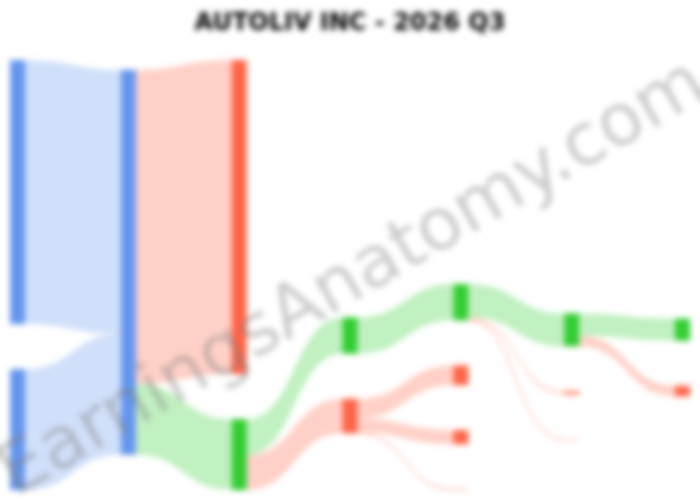
The flow below traces the quarter’s revenue through costs, expenses and profit.
Airbags, steering wheels and other products generated $1.85 billion, about 69% of sales, up 0.9%. Seatbelt products and other sales fell 3.5% to $845 million. These are product categories, not separate reportable operating segments; Autoliv reports one consolidated segment.
Organic sales—excluding currency translation effects—declined 1.1%, outperforming the 1.9% fall in global light-vehicle production cited in the filing. Regional results, however, varied sharply:
Chinese domestic manufacturers accounted for 58% of Autoliv’s China sales, versus 46% a year earlier. That shift demonstrates progress in adapting its customer base, but has not yet fully offset weakness among global manufacturers.
Gross profit fell $26 million to $496 million, and gross margin narrowed from 19.3% to 18.4%. Management attributed the decline mainly to a $13 million supplier-settlement benefit in the prior-year quarter, lower sales and higher logistics costs.
Operating profit received an important offset: net research, development and engineering expense declined $18 million to $99 million.
That was not a reduction in underlying engineering spending. Gross engineering expense increased from $153 million to $160 million, while customer-funded reimbursements rose from $36 million to $62 million. Management described the higher engineering income as timing-related. The distinction matters: lower net expense helped quarterly earnings without demonstrating a comparable structural cost reduction.
Adjusted operating income, which excludes capacity-alignment and antitrust-related items, declined to $262 million, with a 9.7% margin, versus 10.0% a year earlier.
The effective tax rate rose from 26.9% to 32.5%, primarily reflecting unfavorable discrete items associated with closing tax audits. Diluted earnings per share fell from $2.28 to $2.13. A lower share count cushioned the decline; management attributed an $0.11-per-share benefit to that reduction.
Cash distributions also deserve attention. Over nine months, Autoliv generated $305 million in free operating cash flow—operating cash flow less net capital expenditure—but spent $350 million on buybacks and $192 million on dividends. Cash fell from $604 million to $197 million, although its policy leverage ratio remained 1.3 times, below its 1.5-times ceiling.
The takeaway is mixed: Autoliv is outperforming a shrinking production market and expanding with Indian and Chinese customers, but profitability remains pressured. Its full-year 10.5% adjusted operating-margin guidance, versus 9.4% year to date, puts particular emphasis on fourth-quarter execution—and on converting customer gains into stronger margins rather than relying on reimbursement timing.
Last updated: October 23, 2026
Visual breakdowns and margin trends from recent public company SEC filings.
Norwegian Cruise Line Q3 2026: Higher Net Income Masks Weaker Operations
Oct 30, 2026
Read
Citizens Financial Group (CFG) Q3 2026: NII Expansion & Margin Growth
Oct 30, 2026
Read
Chubb Limited Q3 2026 10-Q Analysis: 84.1% Combined Ratio & $1.79B Investment Income
Oct 30, 2026
Read
MGM Resorts Q3 2026: Operating Profit Rebounds as Adjusted EBITDA Falls 20.4%
Oct 30, 2026
Read