Loading blog posts...
October 28, 2026 • 3 min read
Anthropic’s debut on the public markets offers the first comprehensive look behind the curtain of one of the world’s leading artificial intelligence labs. As Claude powers enterprise and consumer workflows worldwide, Anthropic’s newly filed Form S-1 registration statement provides a detailed roadmap of the financial realities driving frontier AI. By digging into the company’s income statement and balance sheet disclosures, we can evaluate how Anthropic is scaling, how its unit economics are evolving, and what lessons can be drawn about the economics of foundation models.
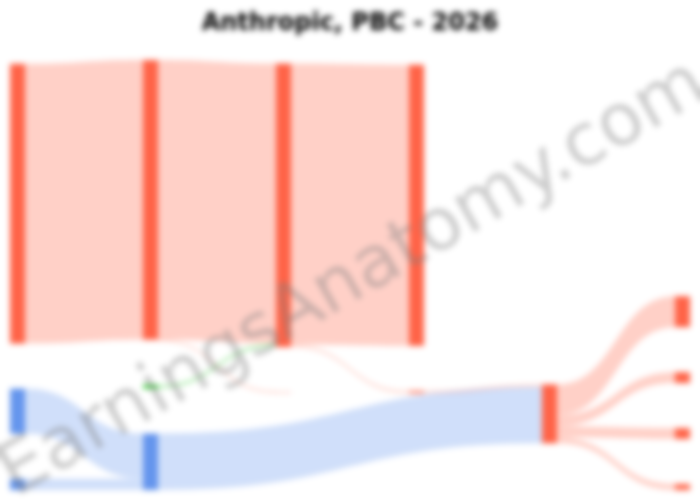
Anthropic generated $16.3 billion in revenue during the first six months of 2026, marking an astonishing 1,300% increase over the $1.16 billion generated in the same period in 2025. Growth was broad-based:
Crucially, Anthropic demonstrated substantial operating leverage. Compute and infrastructure expenses—primarily commitments with cloud service providers (CSPs)—rose from $2.33 billion to $8.95 billion, but fell dramatically as a share of revenue, dropping from 201% in H1 2025 to 55% in H1 2026. Because compute is often secured 12 to 18 months in advance, capacity costs remained relatively fixed while user demand surged.
Consequently, Anthropic’s operating loss compressed from $2.14 billion to $693 million (an operating margin of -4.3%). In the second quarter of 2026 alone, Anthropic achieved positive GAAP operating income of $974 million, delivering $1.62 billion in non-GAAP Adjusted Operating Income for the half-year.
Readers examining the bottom line might be startled by Anthropic’s reported net loss of $80.75 billion. However, this loss does not reflect cash burn from operations. Instead, it stems almost entirely from non-cash accounting rules governing convertible instruments.
Under GAAP fair value accounting, when a private company raises capital via convertible promissory notes or simple agreements for future equity (SAFEs), these liabilities must be marked to fair value each reporting period. Because Anthropic’s enterprise valuation escalated rapidly during early 2026—culminating in massive Series G and Series H funding rounds totaling over $110 billion in net proceeds—the fair value of the debt owed to early noteholders soared.
Anthropic recorded a $72.39 billion non-cash charge for the change in fair value of convertible notes, derivative liabilities, and SAFEs, alongside $8.76 billion in other net expenses primarily related to note purchase agreements with partners like Google and Amazon. On an operational basis, Anthropic's cash flows tell a much healthier story: operating activities generated $3.93 billion in positive cash flow during H1 2026.
Anthropic closed June 2026 with $131.7 billion in cash, cash equivalents, and short-term investments. That liquidity provides necessary ammunition for the fierce infrastructure race against rivals such as OpenAI and Google. The filing reveals massive forward obligations: Anthropic carries $265.6 billion in minimum purchase commitments for CSP hosting alongside $321.4 billion in undiscounted obligations for leases not yet commenced.
To govern this unprecedented scale, Anthropic operates as a Delaware Public Benefit Corporation (PBC). It pairs public safety mandates with a dual safeguard: the Long-Term Benefit Trust (LTBT) controls a majority of board seats through non-economic Class T common stock, while the co-founders retain 50.1% general voting power through Class F stock. As Anthropic enters public markets, balancing hundreds of billions in infrastructure bets with sustainable enterprise monetization will define its next chapter.
Last updated: October 28, 2026
Visual breakdowns and margin trends from recent public company SEC filings.
Norwegian Cruise Line Q3 2026: Higher Net Income Masks Weaker Operations
Oct 30, 2026
Read
Citizens Financial Group (CFG) Q3 2026: NII Expansion & Margin Growth
Oct 30, 2026
Read
Chubb Limited Q3 2026 10-Q Analysis: 84.1% Combined Ratio & $1.79B Investment Income
Oct 30, 2026
Read
MGM Resorts Q3 2026: Operating Profit Rebounds as Adjusted EBITDA Falls 20.4%
Oct 30, 2026
Read