Loading blog posts...
August 6, 2026 • 3 min read
When analyzing technology leaders, examining quarterly financial statements provides invaluable insight into operational execution, segment dynamics, and strategic direction. In this post, we dig into Advanced Micro Devices, Inc.’s (AMD) income statement from its latest 10-Q filing for the second quarter of 2026 (ended June 27, 2026) to see how things are going and what we can learn from the semiconductor giant's performance.
AMD operates across several dynamic hardware markets—data center computing, personal computers (PCs), gaming graphics, and embedded systems—competing head-to-head with major industry players like Nvidia and Intel.
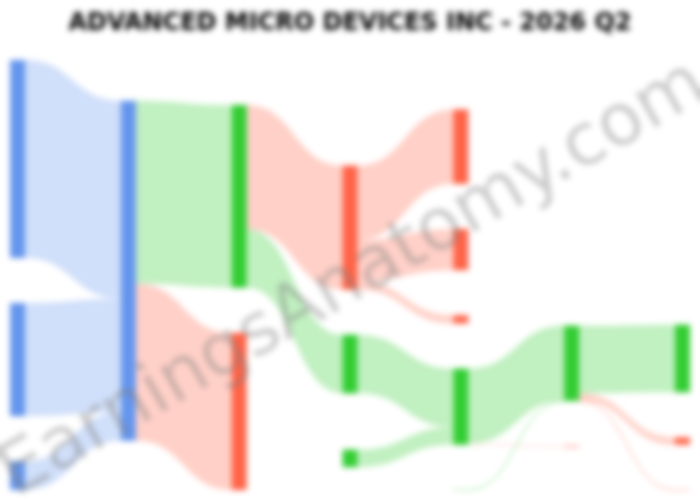
During Q2 2026, AMD generated net revenue of $11.54 billion, representing a 50% year-over-year increase compared to $7.69 billion in Q2 2025. Gross profit surged to $6.20 billion, yielding a gross margin of 53.8%—a significant expansion from 39.8% in the prior-year period.
This margin expansion, combined with operating expenses of $4.21 billion (which included $2.53 billion dedicated to Research & Development), propelled operating income to $1.99 billion. This marks a dramatic turnaround from the $134 million operating loss reported in Q2 2025. Net income reached $2.30 billion, translating to diluted earnings per share (EPS)—a key metric measuring net earnings divided by available shares—of $1.38.
To visualize how AMD’s top-line revenue flows through expenses to generate bottom-line profit, here is the income statement summary for the quarter:
Beyond core operations, AMD's net profit benefited from $598 million in net other income, driven primarily by $483 million in net gains on long-term investments across its strategic technology holdings.
AMD reports its business across three primary divisions: Data Center, Client and Gaming, and Embedded. Performance varied across these units:
AMD finished the quarter with a balance sheet holding $13.11 billion in cash, cash equivalents, and short-term investments, against $3.23 billion in total debt obligations. For the first six months of 2026, operating cash flow from continuing operations reached $5.32 billion—more than double the $2.40 billion generated in the same period of 2025. This robust cash generation provides ample liquidity to fund ongoing innovation in high-performance computing and artificial intelligence hardware.
In a competitive market where enterprise technology spending is heavily shifting toward AI infrastructure, AMD’s Data Center segment is proving to be a dominant catalyst. While console gaming cyclicality remains a temporary drag, AMD’s expanding gross margins and surging enterprise server sales position the company strongly against legacy rivals and GPU competitors.
Last updated: August 6, 2026
Explore prior quarterly filings, historical revenue breakdowns, and earnings trends.
AMD Q1 2026: AI Data Center Surge Drives Massive Growth
May 6, 2026
Read
AMD 2025 10-K Analysis: Data Center Revenue Dominance and Profit Surge
Feb 5, 2026
Read
AMD Q3 2025 Earnings: Gaming Soars, ZT Acquisition Shapes Future
Nov 5, 2025
Read
AMD Q2 2025: Revenue Soars While Data Center Costs Squeeze Profits
Aug 7, 2025
Read