Loading blog posts...
May 6, 2026 • 3 min read
We are digging into the income statement from AMD's latest 10-Q filing to see how the company is performing and what we can learn from its evolving business mix. Advanced Micro Devices (AMD) is a global semiconductor giant best known for its microprocessors (CPUs), graphics processing units (GPUs), and increasingly, its artificial intelligence (AI) accelerators. Competing directly with heavyweights like Nvidia and Intel, AMD's financial health is a strong indicator of broader tech infrastructure trends.
Based on the numbers for the first quarter of 2026, AMD is hitting a massive growth stride, largely fueled by the seemingly insatiable demand for AI compute power.
Total net revenue hit an impressive $10.25 billion for the quarter, marking a massive 38% jump from the $7.44 billion reported in the same period last year. Profitability followed suit, with net income nearly doubling to $1.38 billion, or $0.84 per diluted share, up from $709 million in Q1 2025.
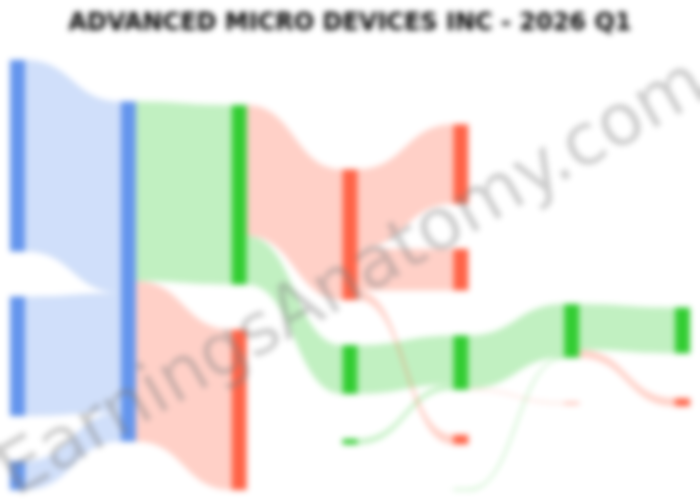
To visualize how this revenue trickled down through the company's costs and expenses to generate that profit, the following chart provides a clear breakdown.
The standout performer this quarter was unquestionably the Data Center segment. Revenue from this division soared 57% year-over-year to $5.8 billion, now accounting for more than half (56%) of AMD's total sales. This segment, which includes the company's EPYC server processors and Instinct AI accelerators, is at the heart of the current AI boom, and its explosive growth single-handedly drove AMD's stellar results.
The company's other segments also posted positive results. The Client and Gaming division, which houses Ryzen CPUs for desktops and notebooks as well as Radeon GPUs, grew a healthy 23% to $3.6 billion, signaling a continued recovery in the PC market. The Embedded segment, which provides chips for networking, automotive, and industrial applications, saw more modest growth of 6% to $873 million.
AMD's success isn't just about revenue; it's also about strategic investment. The company ramped up its Research and Development (R&D) spending by 39% to $2.4 billion. This aggressive investment highlights the high stakes in the semiconductor industry, where constant innovation is critical to staying competitive, especially in the fast-moving AI space. This spending underscores AMD's commitment to challenging its rivals and securing its position as a key player in the AI hardware race.
In conclusion, AMD's first-quarter performance paints a clear picture of a company capitalizing effectively on the AI revolution. While the recovering PC market provides a stable foundation, the Data Center business is now the primary engine of growth and profitability. The key challenge ahead will be sustaining this momentum against fierce competition, and the company's substantial R&D investments show it is fully committed to that fight.
Last updated: May 6, 2026