Loading blog posts...
February 5, 2026 • 4 min read
Advanced Micro Devices, Inc. (AMD) has delivered a robust financial performance for the fiscal year ended December 27, 2025, highlighting a significant pivot toward high-performance computing and data center solutions. With net revenue climbing to $34.6 billion—a substantial increase from $25.8 billion in 2024—the company is capitalizing on the accelerating demand for advanced semiconductor technology.
We dug into the numbers from their latest 10-K filing to break down exactly where this growth is coming from and how the company is managing its expenses to drive profitability.
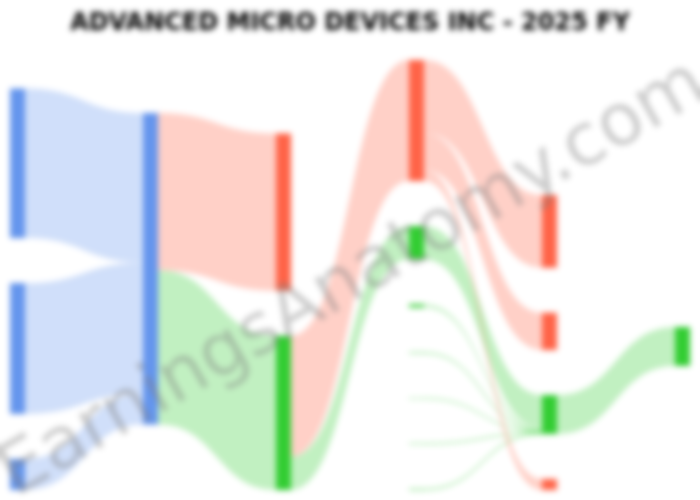
The visualization below illustrates the flow of AMD’s finances for the full fiscal year 2025, showing how revenue from various segments translates into the company's final net income.
The most striking trend in the 2025 filing is the ascendancy of the Data Center segment. This division generated $16.6 billion in net revenue, surpassing the $12.6 billion recorded in the previous year. This segment has effectively become the company's primary revenue engine.
The growth is driven by a portfolio that includes AMD EPYC™ processors for servers and AMD Instinct™ accelerators. The latter are particularly critical, as they are the hardware engines powering Artificial Intelligence (AI) and machine learning workloads—a market currently seeing explosive demand. The segment also covers Data Processing Units (DPUs) and Adaptive SoCs (System-on-Chips), which combine multiple computer components onto a single chip to improve efficiency. With an operating income of $3.6 billion, this segment is not just generating top-line growth but is also a major contributor to the company’s profitability.
While enterprise technology took center stage, the consumer-facing side of the business also reported impressive gains. The Client and Gaming segment combined for $14.6 billion in net revenue, up 51% from $9.6 billion in 2024.
In contrast, the Embedded segment faced headwinds. This division includes FPGAs (Field-Programmable Gate Arrays)—chips that can be reprogrammed after manufacturing for specialized tasks in industrial or automotive settings. Revenue here dipped slightly to $3.5 billion due to mixed demand in certain end markets.
AMD’s operational efficiency improved notably alongside its revenue growth. Net income for the year reached $4.3 billion, a significant leap from the $1.6 billion reported in 2024. This bottom-line growth was achieved despite a substantial increase in Research and Development (R&D) spending, which rose to $8.1 billion (up from $6.5 billion in 2024). In the fiercely competitive semiconductor industry, heavily investing in R&D is vital to maintaining a technological edge against rivals like Intel and NVIDIA.
The company also executed significant strategic moves, most notably the acquisition of ZT Systems. The filing details a total purchase consideration of approximately $4.4 billion for ZT Systems, comprised of cash, stock, and contingent considerations. This move is aimed at bolstering AMD's capabilities in delivering rack-scale solutions for data centers.
As a global semiconductor leader, AMD's exposure to international markets remains a key risk factor. The filing highlights that sales to China (including Hong Kong) accounted for $7.8 billion of net revenue, making it the second-largest market after the United States ($11.4 billion).
Management explicitly notes that government actions, such as export regulations and trade protection measures, could limit the ability to export products to certain customers. Given the significant revenue derived from these regions, investors should remain attentive to the geopolitical landscape, particularly regarding high-performance AI chips.
AMD's fiscal 2025 results paint a picture of a company successfully executing a transition toward data-centric computing while revitalizing its core consumer businesses. With $34.6 billion in revenue and nearly triple the net income of the previous year, the financial foundation appears strong. However, sustaining this momentum will require navigating complex trade regulations and integrating major acquisitions like ZT Systems efficiently as it continues to battle for market share in the high-stakes AI landscape.
Last updated: February 5, 2026
Explore prior quarterly filings, historical revenue breakdowns, and earnings trends.
AMD Q2 2026 Earnings: Data Center Revenue Surges 107%
Aug 6, 2026
Read
AMD Q1 2026: AI Data Center Surge Drives Massive Growth
May 6, 2026
Read
AMD Q3 2025 Earnings: Gaming Soars, ZT Acquisition Shapes Future
Nov 5, 2025
Read
AMD Q2 2025: Revenue Soars While Data Center Costs Squeeze Profits
Aug 7, 2025
Read