Loading blog posts...
August 15, 2026 • 4 min read
Amcor plc is one of the world's largest packaging companies — the maker of flexible films, pouches, bottles, closures and containers that wrap and hold everything from pet food to pharmaceuticals. Its fiscal 2026 (ended June 30, 2026) was the first full year including Berry Global, the $10.4 billion all-stock merger completed on April 30, 2025. That makes this annual 10-K the first clean look at what the combined company actually earns. Let's walk down the income statement.
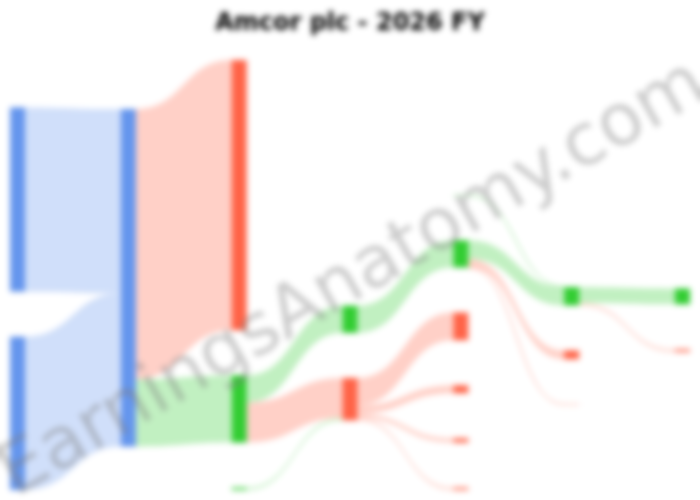
Net sales came in at $23.5 billion, up 57% from $15.0 billion in fiscal 2025. But the pro forma disclosure in the filing is the more honest yardstick: had Berry been owned for all of fiscal 2025, combined sales would have been $23.2 billion. In other words, the underlying business grew roughly 1% — the headline growth is almost entirely the arithmetic of consolidating an acquisition for 12 months instead of two.
The segment split is now nearly balanced. Global Flexible Packaging Solutions (films, pouches and specialty cartons for food, beverage, medical and personal care) generated $12.8 billion of sales, 55% of the total, with adjusted segment EBIT of $1,789 million — a 13.9% margin, identical to last year. Global Rigid Packaging Solutions (containers, preforms and closures, now supercharged by Berry's consumer packaging businesses) more than doubled to $10.7 billion, and its adjusted EBIT margin expanded from 8.8% to 11.0%. That margin lift is the clearest evidence of the merger thesis working: Amcor says it captured roughly $285 million of Berry synergies in fiscal 2026, ahead of its original $260 million target.
The gap between the $2,965 million of combined segment EBIT and the $1,899 million of reported operating income is a hefty $1,066 million of unallocated items — $558 million of amortization on acquired intangibles, $266 million of restructuring and integration, $152 million of corporate costs, plus hyperinflation charges from Argentina and portfolio-review expenses.
Gross margin improved to 20.0% from 18.9%, and operating margin to 8.1% from 6.7%. Below the operating line, though, the merger's financing shows up: interest expense jumped 71% to $676 million, swallowing more than a third of operating income. Net interest of $610 million is why an 8.1% operating margin becomes a 4.7% net margin.
Net income reached $1,106 million ($2.38 diluted EPS, versus $1.60), but a meaningful slice came from tax. Amcor's effective tax rate fell to 14.1% from 20.8%, helped by U.S. "unified loss rules" (–3.5 points), a release of Australian valuation allowances (–2.4 points) and reversals of uncertain tax positions (–2.5 points). At last year's rate, net income would have been closer to $1.0 billion. Adjusted net income, which strips out amortization and integration costs, was $1,863 million.
Operating cash flow rose to $2.15 billion from $1.39 billion, funding $922 million of capex and $1,195 million of dividends. Note that dividends exceeded reported net income — retained earnings fell from $548 million to $459 million — and no share buyback program was in place. Net debt eased to $12.9 billion from $13.3 billion, and management redeemed $2.1 billion of legacy Berry secured notes during the year.
Goodwill and acquired intangibles now total $18.7 billion — half of Amcor's $37.1 billion balance sheet, and the auditors flagged goodwill impairment testing for the Rigid Packaging unit as a critical audit matter. Meanwhile, five-year total shareholder return sits at $96.64 per $100 invested, versus $187.57 for the S&P 500.
Against peers like Sealed Air, Sonoco, Silgan and Graphic Packaging (where new CFO Stephen Scherger spent a decade), Amcor's story for the next year is less about growth than execution: harvesting the $530 million synergy target by fiscal 2028, pruning non-core assets, and deleveraging — all while transitioning to a December 31 year-end via a six-month reporting stub.
Last updated: August 15, 2026
Explore prior quarterly filings, historical revenue breakdowns, and earnings trends.