Loading blog posts...
February 13, 2026 • 4 min read
Airbnb, Inc. has firmly established itself as a verb in the travel industry, fundamentally changing how people experience new cities. But as the company matures from a high-growth disruptor into a market staple, investors are keen to see how it balances expansion with operational efficiency. Let’s unpack the numbers from their latest 10-K filing to see how the platform performed in 2025.
Airbnb delivered a solid year for top-line growth. Total revenue climbed to $12.2 billion, a 10% increase from the previous year. This growth was fueled by strong booking activity, with Nights and Seats Booked rising 8% to 533 million.
A critical metric for platform businesses like Airbnb is Gross Booking Value (GBV), which represents the total dollar value of bookings on the platform (including host earnings, service fees, cleaning fees, and taxes). GBV surged 12% to reach $91.3 billion. This double-digit growth suggests that despite macroeconomic uncertainties, consumer demand for travel and unique accommodations remains resilient.
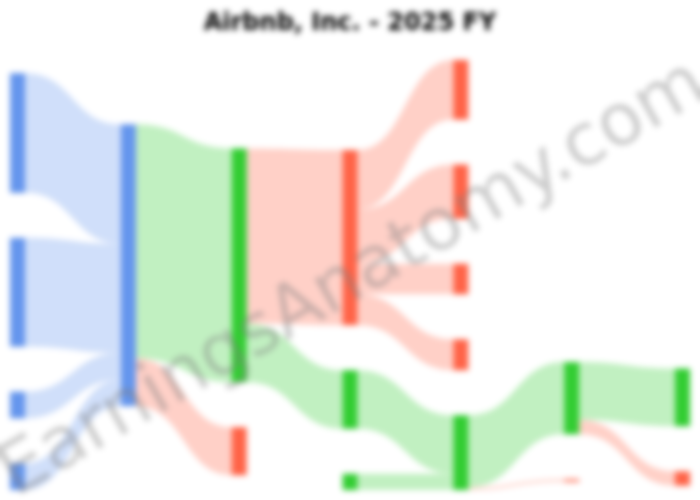
To visualize how that top-line revenue trickles down through the company's expenses to the bottom line, take a look at the flow diagram below:
While revenue hit record highs, net income actually took a slight step back. Airbnb reported a Net Income of $2.5 billion for 2025, down roughly 5% from $2.6 billion in 2024. Consequently, the net profit margin compressed from 24% to 21%.
Digging into the expense lines reveals why profit didn't scale perfectly with revenue:
Airbnb's global footprint shows interesting divergences. While North America remains the largest revenue source at $5.2 billion, its growth was modest at 4%. The real momentum is found internationally:
This data highlights a strategic shift where emerging markets and European travel are driving the next leg of volume growth as the North American market saturates.
Despite the dip in net income, Airbnb remains a cash-generating machine. Free Cash Flow (FCF)—a measure of the cash a company generates after accounting for cash outflows to support operations and maintain its capital assets—reached $4.6 billion, up from $4.5 billion the prior year.
Management utilized this liquidity to return value to shareholders, repurchasing 29.7 million shares of Class A common stock for a total of $3.8 billion. This substantial buyback activity often signals management's belief that the stock is undervalued relative to its long-term potential.
Airbnb continues to navigate a complex landscape of regulatory challenges (such as short-term rental bans in major cities) and fierce competition from traditional hotels and Online Travel Agencies (OTAs). However, with over $91 billion in booking value flowing through its system and a pristine balance sheet, the company remains well-positioned to invest in new products and expand its reach into less mature markets.
Last updated: February 13, 2026
Explore prior quarterly filings, historical revenue breakdowns, and earnings trends.