Loading blog posts...
September 2, 2026 • 4 min read
Agilent Technologies is one of those companies whose products sit quietly behind almost every scientific headline. The Santa Clara-based firm makes chromatographs, mass spectrometers, lab consumables, pathology reagents and the services that keep labs running — competing with Thermo Fisher, Danaher, Waters, Bruker, Revvity and Shimadzu. Its fiscal third quarter ended July 31, 2026, and the 10-Q it just filed shows a quarter where the top line grew respectably but the margin line did most of the heavy lifting.
Let's dig into the income statement to see where the money actually came from.
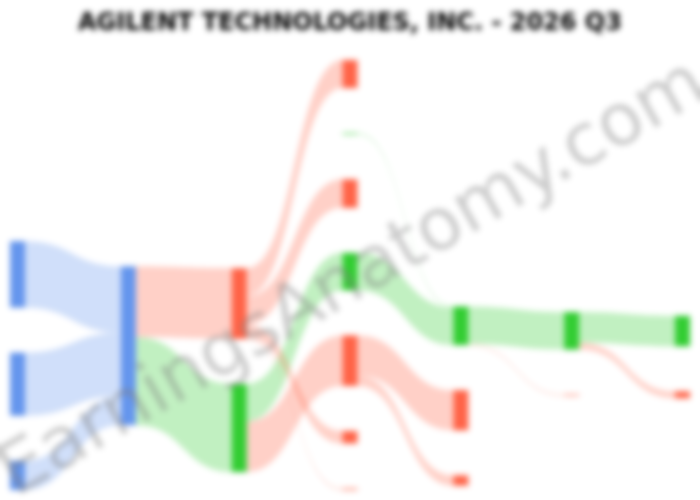
Total net revenue hit $1,878 million, up 8% from $1,738 million a year ago, split between products ($1,333M, +8%) and services and other ($545M, +7%).
The striking part: total cost of revenue actually fell to $836 million from $850 million, even as revenue grew 8%. That pushed gross margin to 55.5% from 51.1% — a 4.4-percentage-point swing that is unusually large for an instrument maker. Management flagged a net benefit from tariff refunds (worth roughly $0.06 of full-year EPS) as one driver; lower restructuring charges buried in cost of products ($1M this quarter versus $7M last year) and a swing in hedge-related reclassifications helped too.
The $18 million of unallocated cost of revenue in the flow diagram is part of $88 million in total corporate costs Agilent strips out of segment results — amortization of acquisition intangibles ($21M), acquisition and integration costs ($7M), restructuring ($15M) and "transformational initiatives" ($37M, more than double last year's $18M) as the company reengineers its operating model.
Operating expenses rose faster than sales: R&D up 10% to $123M and SG&A up 14% to $475M. Still, income from operations climbed 23% to $444 million, a 23.6% operating margin versus 20.7%.
Here's the catch. Pretax income rose 21% to $444M, but net income advanced just 8% to $362 million. The culprit is tax: the provision jumped to $82 million from $30 million, an effective rate of ~18.5% versus a benefit-inflated ~8.2% last year. Diluted EPS of $1.28 (vs. $1.18) got a small assist from buybacks — 283M diluted shares versus 285M, after $295M of repurchases over nine months.
By end market, pharma and biotech led at $707M (+12%) and diagnostics/clinical at $284M (+10%), while academia and government slipped 3% to $128M — a reminder that public research budgets remain a soft spot. Encouragingly, "non-instrumentation and other" revenue — consumables and services — was $1,235M, or 66% of the total, giving Agilent a recurring base that cushions capital-equipment cycles.
On June 24, Agilent closed its $964 million cash acquisition of Biocare Medical, a maker of immunohistochemistry and molecular pathology instruments and antibodies used in cancer diagnostics. The purchase price allocation shows $549M of goodwill and $520M of intangibles ($372M customer relationships, $145M developed technology). Goodwill rose to $5.03B and other intangibles more than doubled to $906M. Agilent funded it with $600M of new 2032 senior notes, lifting long-term debt from $3.05B to $3.65B while keeping cash roughly flat at $1.76B.
Nine-month revenue of $5.51B (+8%) and EPS of $3.55 (+16%) support the raised full-year outlook of $7.49–$7.51B in revenue and $6.18–$6.21 in non-GAAP EPS. The open question is durability: a chunk of this quarter's margin expansion came from tariff refunds and easier restructuring comparisons, while SG&A growth of 14% is running well ahead of revenue. With academic funding soft and rivals like Thermo Fisher and Danaher chasing the same pharma recovery, Agilent's recurring CrossLab franchise and its push deeper into cancer diagnostics look like the more reliable growth levers.
Last updated: September 2, 2026
Explore prior quarterly filings, historical revenue breakdowns, and earnings trends.
Agilent Q2 2026: 10% Revenue Growth and a 58% Profit Surge
Jun 2, 2026
Read
Agilent Q1 2026 Earnings: Solid Revenue Growth Squeezed by Surging SG&A
Mar 6, 2026
Read
Agilent Technologies FY2025: Revenue Growth vs. Margin Compression
Dec 22, 2025
Read
Agilent Q3 2025: Revenue Climbs but Margins Tighten
Aug 30, 2025
Read