Loading blog posts...
June 2, 2026 • 3 min read
When a company’s stock surges nearly 17% following an earnings release, it is usually a strong signal that Wall Street liked what it saw. To see what all the excitement is about, we need to dig into the income statement from Agilent Technologies and see how things are going and what we can learn from it. Agilent is a major player in the life sciences and diagnostics space—providing the complex analytical instruments, software, and consumables that pharmaceutical companies, hospitals, and research labs rely on to conduct their work. If you are familiar with heavyweights like Thermo Fisher Scientific or Danaher, Agilent competes in that same high-tech neighborhood.
Let's unpack the numbers from their latest 10-Q filing for the second quarter of fiscal 2026.
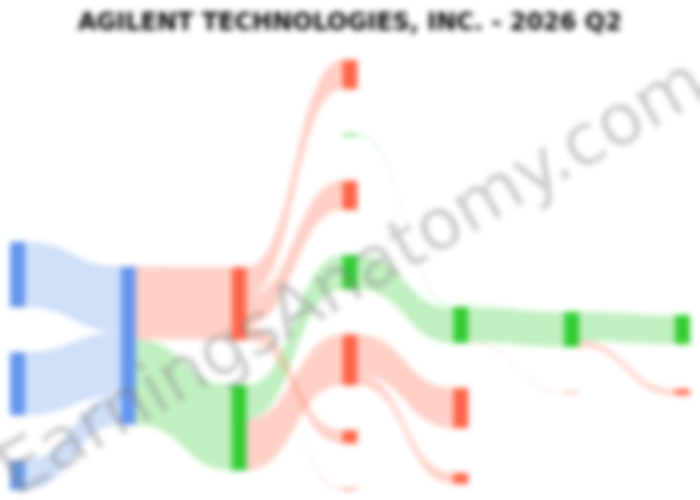
For the quarter ended April 30, 2026, Agilent reported total net revenue of $1.84 billion, a solid 10% increase compared to the $1.67 billion generated in the same period last year. This growth was well-balanced, with product sales (like lab instruments) climbing 10% to $1.31 billion, and services bringing in $530 million, also up 10%.
What is even more impressive is how that revenue translated into profit. Net income skyrocketed by 58% to reach $339 million, up from $215 million in the prior year. Diluted earnings per share (EPS) followed suit, hitting $1.20 compared to $0.75 a year ago.
Agilent operates through three main business segments, all of which posted healthy year-over-year gains:
A key takeaway from the filing is Agilent’s improved profitability. Total gross margin—the percentage of revenue left after covering the direct costs of making products and delivering services—expanded by 200 basis points to 54.0%.
Operating margins also saw a massive boost, jumping from 18.0% to 21.7%. A significant portion of this improvement comes from leaner operations and a sharp drop in restructuring expenses. In the second quarter of 2025, Agilent took a $56 million hit for restructuring; this quarter, that expense fell to just $8 million as the company winds down its Fiscal Year 2025 optimization plan.
Agilent is also returning capital to its investors. During the quarter, the company repurchased 550,000 shares of common stock for $65 million and declared $72 million in cash dividends.
Following periods of budget tightening across the pharmaceutical and biotech industries, Agilent’s latest filing suggests that capital spending in laboratories is recovering nicely. By pairing double-digit revenue growth with disciplined cost controls and a winding down of its restructuring programs, Agilent has positioned itself to extract maximum profit from this renewed demand. In a competitive landscape alongside other life science giants, Agilent's balanced growth across instruments, consumables, and services proves it remains a crucial backbone for the global scientific community.
Last updated: June 2, 2026
Explore prior quarterly filings, historical revenue breakdowns, and earnings trends.
Agilent Q3 FY2026: Margins Jump to 55.5% as Biocare Deal Reshapes Diagnostics
Sep 2, 2026
Read
Agilent Q1 2026 Earnings: Solid Revenue Growth Squeezed by Surging SG&A
Mar 6, 2026
Read
Agilent Technologies FY2025: Revenue Growth vs. Margin Compression
Dec 22, 2025
Read
Agilent Q3 2025: Revenue Climbs but Margins Tighten
Aug 30, 2025
Read