Loading blog posts...
August 7, 2026 • 4 min read
Digging into a power utility's income statement offers a clear view into how major secular trends—such as renewable energy expansion, interest rate fluctuations, and grid modernization—translate into bottom-line performance. The AES Corporation (AES) is a major global energy infrastructure provider operating power generation, energy storage, and regulated utility networks across the Americas and Asia. Competing alongside utility leaders like NextEra Energy and Constellation Energy, AES plays a vital role in balancing grid reliability with clean energy adoption. Let's unpack the numbers from their latest 10-Q filing to see how operational execution across their core business divisions is driving profitability and shaping their financial health.
During the second quarter of 2026 (three months ended June 30, 2026), AES demonstrated robust financial momentum compared to the same period in 2025. Total revenue surged by 20% to $3.42 billion, up from $2.86 billion in Q2 2025.
This top-line expansion helped drive a dramatic profitability turnaround: net income reached $387 million (with $426 million attributable to AES Corporation common stockholders), representing a sharp recovery from the net loss of $150 million reported in Q2 2025. On a per-share basis, basic and diluted earnings per share (EPS)—the portion of net income allocated to each outstanding share of common stock—rebounded to $0.60, compared to a loss of $0.15 per share in the prior-year period.
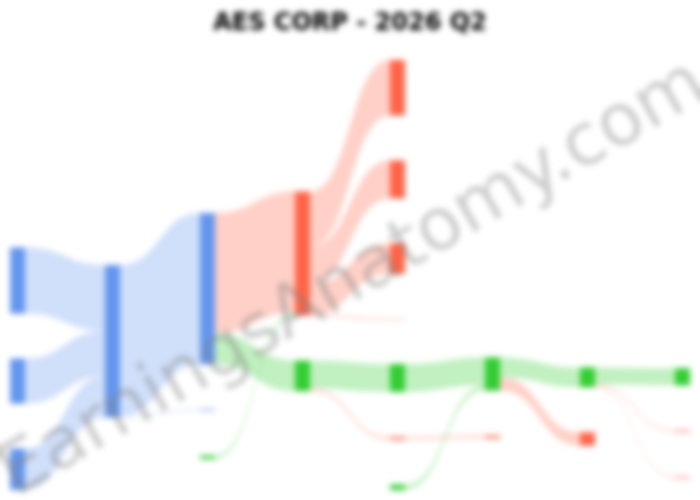
The income statement flow diagram above illustrates how Q2 2026 revenue translated into costs, operating expenses, and net profit. In the diagram, unallocated revenue stands at -$31 million (reflecting $39 million in corporate and other revenue reduced by $70 million in inter-segment eliminations) and unallocated cost of revenue stands at -$80 million (reflecting $(25) million in corporate and other cost of sales combined with $(55) million in eliminations).
Total cost of revenue for the quarter reached $2.73 billion, leaving a gross profit (or operating margin) of $692 million—an overall gross margin of 20.2%. General and administrative (G&A) expenses were kept at $62 million, yielding an operating income of $630 million (an 18.4% operating margin). Non-operating items included $368 million in interest expense and $122 million in net other income, bringing income before taxes to $449 million and net income to $387 million after tax expense of $28 million and net equity losses from affiliates of $34 million.
AES operates through four main Strategic Business Units (SBUs):
Beyond quarterly operational growth, AES is navigating major strategic and macroeconomic developments. In March 2026, AES entered into a definitive merger agreement to be acquired by Horizon Parent, L.P.—a consortium led by Global Infrastructure Partners (GIP) and EQT—for $15.00 per share in cash, a deal approved by AES shareholders in June 2026. Operationally, management continues to monitor interest rate volatility, evolving U.S. Treasury guidelines regarding Investment Tax Credits (ITC) and Production Tax Credits (PTC), and supply chain timing across its project pipeline.
AES's Q2 2026 results reflect strong operational execution, highlighted by a 20% revenue increase to $3.42 billion and a return to net profitability of $387 million. Expanding renewable capacity alongside steady utility rate bases provides strong cash flow visibility. As AES moves toward completing its pending private buyout by GIP and EQT, its core generation and distribution assets remain key pillars in navigating the global energy transition.
Last updated: August 7, 2026
Explore prior quarterly filings, historical revenue breakdowns, and earnings trends.