Loading blog posts...
July 24, 2026 • 3 min read
Welcome back to our earnings deep-dive series. Today, we are unpacking the latest numbers from Southwest Airlines Co. (LUV) by digging into their Q2 2026 10-Q filing to see how things are going and what we can learn from their financial performance.
For those unfamiliar, Southwest is a titan of the U.S. domestic airline industry. Long known for its uniform fleet of Boeing 737s, free checked bags, and open-seating policy, the airline has recently been undergoing a massive commercial transformation—including a shift toward assigned and premium seating—to boost profitability. With activist investor Elliott Management holding a substantial position and demanding structural changes, all eyes are on how these internal initiatives are translating to the bottom line.
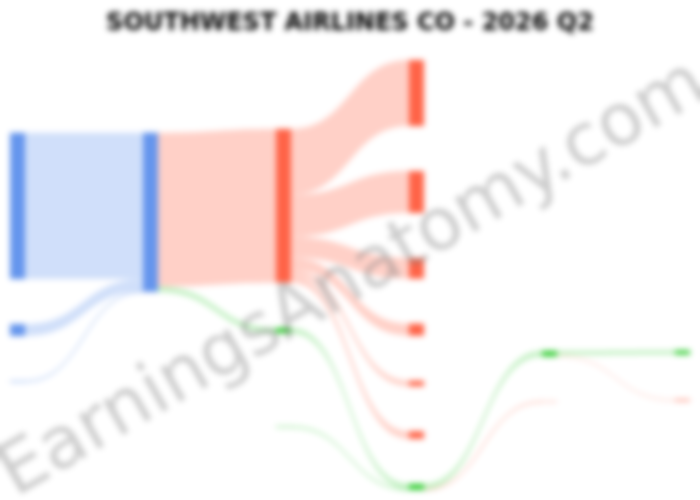
Let's visualize the journey from top-line revenue to bottom-line profit.
As the diagram shows, Southwest brought in a massive $8.43 billion in total operating revenue this quarter. That’s a company record and a 16.4% jump compared to Q2 2025. Unsurprisingly, the vast majority of this ($7.75 billion, or roughly 92%) came directly from passenger revenue, while freight and other ancillary revenues made up the rest.
But what's really fascinating is a hidden accounting quirk that actually depressed that revenue number.
In airline accounting, there is a concept known as "breakage." When customers cancel flights and receive flight credits, airlines estimate how many of those credits will eventually expire unused and record that expected unredeemed value as revenue.
During this quarter, Southwest recorded a $285 million negative adjustment to its passenger revenue to reverse breakage recognized between July 2022 and December 2025. Essentially, historical patterns of unredeemed credits shifted, meaning customers used more of their credits than expected, forcing the airline to adjust its estimates. If we strip out this special one-time penalty, Southwest's adjusted operating revenue was actually $8.72 billion—up over 20% year-over-year.
If top-line revenue was the good news, operating expenses were the turbulence. Total operating expenses hit $8.15 billion, driven heavily by an industry-wide headache: jet fuel.
Southwest’s aircraft fuel and related taxes skyrocketed 67% year-over-year to $2.22 billion. The company paid $3.92 per gallon this quarter, compared to just $2.32 in the same period last year. Despite this massive $889 million increase in fuel expenses, the airline largely maintained its cost discipline elsewhere. Salaries, wages, and benefits rose a modest 7.3% to $3.5 billion, while maintenance materials and repair costs actually dropped by 11.2% to $294 million.
Despite the $285 million accounting reversal and the massive fuel shock, Southwest still landed a profitable quarter. The company reported GAAP net income of $233 million (a 2.8% net margin), translating to a diluted EPS of $0.47. However, if we look at non-GAAP net income—which excludes the breakage reversal and other special items—profit actually more than doubled year-over-year to $465 million, or $0.94 per share.
Southwest's Q2 2026 income statement proves that the airline is successfully pulling new commercial levers. Higher average passenger fares (up nearly 21% to $225.61) and strong demand helped the company completely absorb a brutal spike in fuel costs.
However, the skies ahead remain cloudy. The persistent volatility of jet fuel prices recently forced management to lower their full-year profit floor, reminding investors that even the best-laid transformational plans are subject to macroeconomic weather. As Southwest continues to roll out its "New Southwest" initiatives, it will serve as a fascinating case study in whether internal revenue optimization can consistently outpace external cost shocks.
Last updated: July 24, 2026
Explore prior quarterly filings, historical revenue breakdowns, and earnings trends.