Loading blog posts...
October 23, 2026 • 4 min read
Southwest Airlines Co. (NYSE: LUV) has spent the past several quarters executing a broad commercial transformation to revitalize its profitability. Our goal today is to dig into the income statement from the airline's latest Q3 2026 Form 10-Q filing to see how the business is performing and what insights we can extract from the numbers.
For the third quarter ended September 30, 2026, Southwest delivered a dramatic improvement in its bottom line, with net income surging fivefold to $270 million ($0.55 per diluted share), up from $54 million ($0.10 per diluted share) in Q3 2025. Even more telling is how the carrier achieved this: despite a massive spike in jet fuel prices, strong ticket pricing and booming ancillary revenues allowed Southwest to expand its operating margins from 0.5% a year ago to 4.5% this quarter.
Total operating revenues jumped 21.2% year-over-year to $8.42 billion. Interestingly, this top-line growth was not driven by flying more planes or cramming in more flyers. Available seat miles (ASMs)—a standard industry measure of passenger carrying capacity—actually dipped slightly by 0.4%, while load factor (the percentage of seats filled) remained flat at 79.8%.
Instead, Southwest generated significantly more revenue per seat. Operating revenue per ASM (RASM) climbed 21.6% to 18.55 cents, fueled by a 26.9% surge in average passenger fares to $231.69.
Breaking down the $7.75 billion in passenger revenue reveals how customer monetization is evolving:
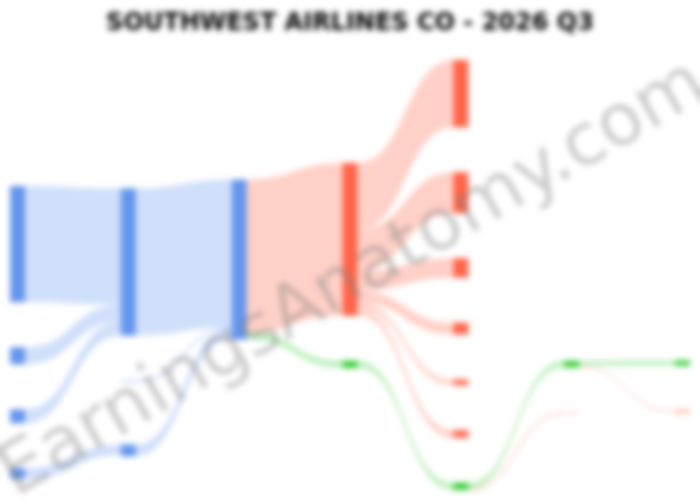
The diagram below maps out Southwest’s Q3 2026 income statement, tracing how these revenue streams flow through operating expenses down to net profit.
While revenue soared, operating expenses also climbed 16.3% to $8.04 billion. The primary culprit was the fuel pump: aircraft fuel and related taxes surged 61.7% from $1.33 billion in Q3 2025 to $2.15 billion in Q3 2026. Average fuel costs per gallon jumped from $2.40 to $3.92, including $29 million in hedging premium expenses reclassified from prior fuel contracts.
Meanwhile, salaries, wages, and benefits—Southwest's largest single expense category—increased 10.0% to $3.54 billion, partly reflecting a $62 million profit-sharing accrual (up from $11 million last year) alongside $30 million in corporate workforce severance costs.
To help offset these pressures, Southwest leaned on fleet monetization and accounting adjustments:
Excluding special items like $30 million in severance and $30 million in asset impairments, non-GAAP operating income reached $452 million, up more than tenfold from $42 million in Q3 2025.
A major operational milestone noted in the filing is that the FAA completed its certification of the Boeing 737 MAX 7 (-7) on August 3, 2026. Southwest expects its first -7 delivery in late 2026, with entry into service slated for 2027. Combined with $3.62 billion in cash on hand and $1.25 billion in share buybacks completed earlier in the year, the airline's balance sheet remains solid.
Ultimately, Q3 2026 demonstrates that Southwest's commercial overhaul is gaining real traction. In a competitive U.S. aviation market where legacy carriers like Delta, United, and American have long dominated premium and ancillary revenue streams, Southwest is proving it can command higher fares and monetize add-ons effectively—enough to absorb a 63% jump in fuel prices and still multiply its profits.
Last updated: October 23, 2026