Loading blog posts...
April 25, 2026 • 3 min read
Rollins, Inc. (NYSE: ROL), the parent company behind the ubiquitous Orkin brand, operates in an essential and remarkably resilient industry: pest control. Known for its historical consistency and compounding growth, Rollins rarely delivers massive surprises, but analyzing its financials offers a masterclass in steady business execution. Let's unpack the numbers from its latest 10-Q filing to see how the company performed in early 2026 and what we can learn from its income statement.
The first quarter reveals a story of continued, impressive top-line growth, alongside some emerging pressure on profitability as costs begin to outpace sales.
For the first quarter of 2026, Rollins reported total revenues of $906.4 million, a robust 10.2% increase from the $822.5 million generated in the same period last year. This marks an astounding 98th consecutive quarter of revenue growth—a multi-decade streak that underscores the defensive, non-discretionary nature of the pest control market.
This top-line growth was broad-based across its primary service lines:
While strategic buyouts are a core part of Rollins' playbook—the company consistently acquires smaller operators to expand its footprint—the underlying business remains highly competitive. The company reported that organic revenue (which strips out the impact of recent acquisitions) grew by a healthy 6.6%, demonstrating strong customer retention, pricing power, and organic route density growth.
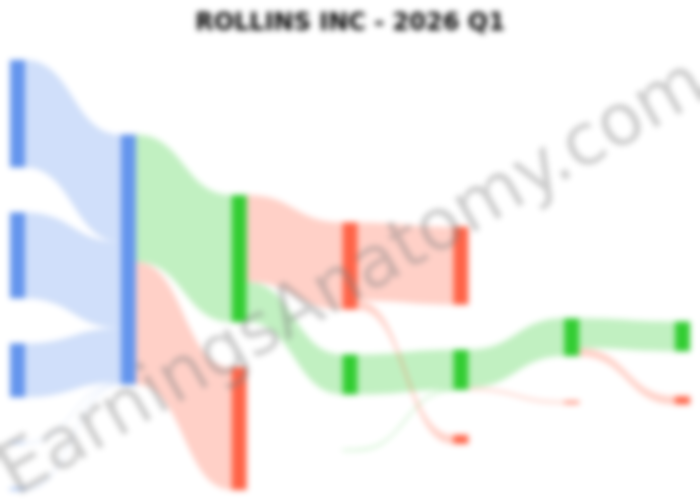
To better understand how Rollins' revenue translates into profit, the following flow diagram visualizes the company's income statement for the first quarter.
While revenue growth remains impressive, a closer look at the income statement reveals mounting cost pressures. Gross profit margin for the quarter dipped slightly to 50.8% from 51.4% a year earlier.
More significantly, Sales, General, and Administrative (SG&A) expenses rose 12.9% to $282.9 million. This outpaced revenue growth and was driven by higher costs across several categories, including a 14.0% increase in selling and marketing expenses and a 25.8% jump in insurance and claims within SG&A.
As a result, operating income grew by a modest 2.0% to $145.5 million, and the company's operating margin compressed by 120 basis points, falling from 17.3% in Q1 2025 to 16.1% in Q1 2026. This highlights a key challenge: converting strong top-line gains into proportional bottom-line growth.
The margin compression flowed through to the bottom line. Net income for the quarter was $107.8 million, a 2.5% increase from the prior year—solid, but lagging far behind the 10.2% revenue growth.
This resulted in a flat earnings per share (EPS) of $0.22, the same as in Q1 2025. This was partly influenced by a slight reduction in the weighted average diluted share count, which fell from 484.4 million to 481.4 million. While the company withholds shares to cover employee tax obligations, it did not repurchase any shares on the open market during the quarter.
In conclusion, Rollins continues to demonstrate its strength as a reliable grower in a defensive industry. However, the first quarter of 2026 underscores the challenge of managing inflation and operational costs. While the company's powerful brands and acquisition strategy position it well for continued expansion, maintaining and improving profitability in the face of rising expenses will be the key narrative for investors to watch moving forward.
Last updated: April 25, 2026
Explore prior quarterly filings, historical revenue breakdowns, and earnings trends.
Rollins Q3 2026 10-Q Analysis: Steady Revenue Growth vs. Rising Fleet and Insurance Costs
Oct 22, 2026
Read
Rollins Inc (ROL) Q2 2026 10-Q Analysis: 99 Quarters of Growth
Jul 29, 2026
Read
Rollins (ROL) 2025 10-K: Double-Digit Growth & Margin Resilience
Apr 2, 2026
Read
Rollins Inc. (ROL) Q3 2025 10-Q: Dissecting 12% Revenue Growth
Nov 18, 2025
Read