Loading blog posts...
July 24, 2026 • 5 min read
PG&E’s latest quarter is a useful reminder that utility income statements are shaped not only by customer demand and operating costs, but also by regulation, wildfire-related accounting, and financing. The goal here is to dig into PG&E Corporation’s income statement from its latest Form 10-Q, see how the business is performing, and pull out the numbers that matter most.
PG&E Corporation is the holding company for Pacific Gas and Electric Company, one of California’s largest regulated electric and natural gas utilities. Its results are closely watched because the company sits at the intersection of grid investment, wildfire risk, customer affordability, and California energy policy.
For the second quarter of 2026, PG&E reported total operating revenue of $5.90 billion, essentially unchanged from $5.90 billion a year earlier. But profitability improved meaningfully: net income rose to $761 million, up from $549 million in Q2 2025. Income available to common shareholders was $733 million, or $0.33 per diluted share, compared with $521 million, or $0.24 per diluted share, last year.
The key point: PG&E did not need revenue growth to expand earnings. Operating income increased to $1.26 billion, up 15% from $1.10 billion a year ago, as expenses moved in a favorable direction.
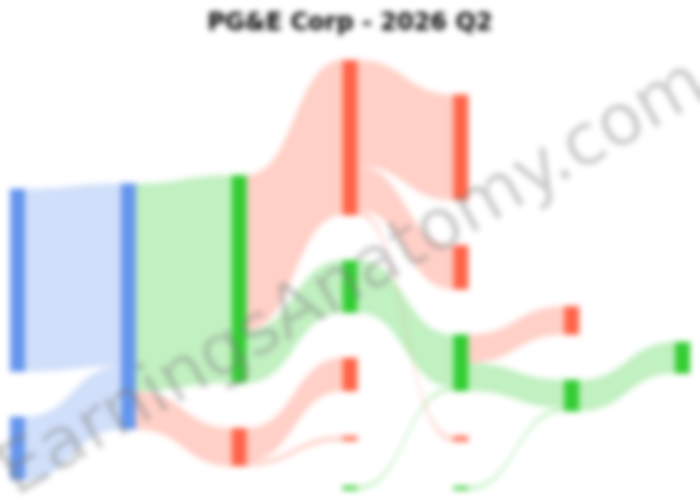
Here is the quarterly income statement flow:
Electric revenue accounted for $4.39 billion, or roughly 74% of total revenue, while natural gas contributed $1.51 billion, or 26%. Electric revenue slipped 1% year over year, while gas revenue rose 2%. Beneath those headline numbers, regulatory balancing accounts played a major role. These accounts are mechanisms that allow regulated utilities to track costs or revenues that will later be collected from, or refunded to, customers. In Q2, electric operating revenue included a $641 million reduction from regulatory balancing accounts, while gas revenue included a $646 million increase.
PG&E’s cost of electricity rose 34% year over year to $800 million, while the cost of natural gas was relatively stable at $115 million. That would normally pressure margins, but the company more than offset it through lower operating expenses.
Operating and maintenance expense fell to $2.54 billion, down from $2.86 billion in the prior-year quarter. Wildfire-related claims, net of recoveries, were zero this quarter versus $50 million last year. Meanwhile, Wildfire Fund expense increased to $126 million, up from $109 million. The Wildfire Fund, established under California’s AB 1054 framework, is designed to help participating utilities pay eligible wildfire claims after certain conditions are met.
Depreciation, amortization, and decommissioning expense was $1.06 billion, roughly flat year over year. That line remains large because PG&E is a capital-intensive utility investing heavily in poles, wires, gas infrastructure, and generation-related assets.
Below operating income, PG&E’s financing burden remains significant. Consolidated interest expense was $796 million in Q2, slightly above $792 million last year. Interest income declined to $110 million from $181 million, so net interest expense weighed heavily on pre-tax earnings.
Even so, PG&E’s bottom line benefited from an income tax benefit of $87 million, compared with a $20 million tax provision in Q2 2025. That tax benefit helped push net income above income before taxes, which was $674 million.
The capital picture is also important. For the first six months of 2026, PG&E generated $3.34 billion of operating cash flow but spent $6.32 billion on capital expenditures, resulting in negative free cash flow of roughly $3.0 billion. The company funded the gap through financing activity, including $5.37 billion of long-term debt proceeds and $4.79 billion of credit facility borrowings, partly offset by repayments.
The filing highlights several major developments. In April 2026, the NRC approved a 20-year license renewal for Diablo Canyon Power Plant, an important asset in California’s electricity supply mix. PG&E also continues to pursue major regulatory recovery proceedings, including wildfire mitigation and catastrophic event costs. One notable item: the company’s 2023 WMCE proceeding sought $2.18 billion of cost recovery, with a final decision authorizing $1.9 billion issued in February 2026.
Wildfire exposure has not disappeared. PG&E disclosed cumulative payments of $2.34 billion related to the 2021 Dixie Fire and 2022 Mosquito Fire through June 30, 2026, along with probable recoveries of $2.41 billion for Dixie and $478 million for Mosquito from sources including insurance, regulatory mechanisms, and the Wildfire Fund.
PG&E’s Q2 income statement shows a utility with flat revenue but stronger earnings, helped by lower operating and maintenance costs, no net wildfire claims expense in the quarter, and a tax benefit. At the same time, the company remains highly capital intensive and heavily financed, with interest expense and regulatory recovery timing central to the investment case.
For readers comparing PG&E with other large regulated utilities such as Edison International’s Southern California Edison or Sempra’s San Diego Gas & Electric, the core issue is not just quarterly earnings growth. It is whether PG&E can keep investing in grid safety and reliability while managing wildfire liabilities, customer affordability, and a large debt-funded capital program.
Last updated: July 24, 2026
Explore prior quarterly filings, historical revenue breakdowns, and earnings trends.