Loading blog posts...
May 6, 2026 • 3 min read
As a titan in the digital payments world, PayPal's performance serves as a key indicator of e-commerce health and consumer spending habits. To understand how the company is performing in a dynamic market, we've analyzed the income statement from its most recent quarterly filing. The results for the first quarter of 2026 show a company with solid top-line growth, but one that is also grappling with rising costs that are putting pressure on its profitability.
PayPal's net revenues for the quarter reached $8.4 billion, a 7% increase from the same period last year. This growth was driven by a rise in both transaction revenues, which climbed 7% to $7.5 billion, and revenues from other value-added services (like credit products and partnership fees), which saw a healthy 10% jump to $852 million. This performance was underpinned by an 11% increase in Total Payment Volume (TPV), which reached an impressive $464 billion for the quarter.
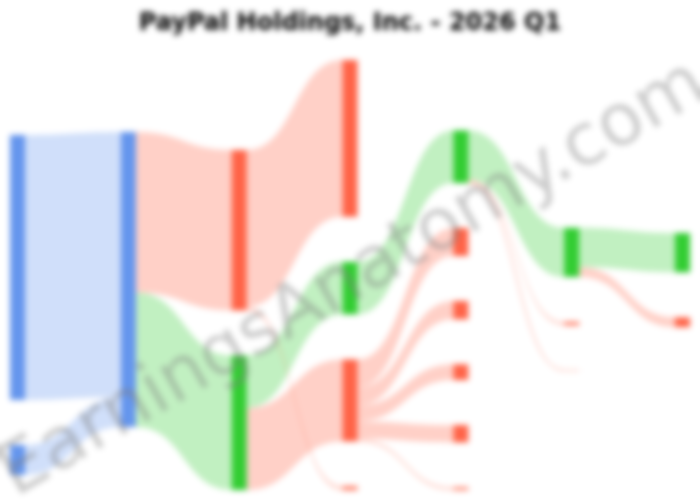
This flow diagram illustrates how the company's revenue is allocated across its various expenses to arrive at its net income.
While revenue grew, operating expenses climbed at a faster rate, increasing by 10% to $6.9 billion. The primary driver was a 12% rise in transaction expenses—the fees PayPal pays to banks and payment processors—which totaled $4.2 billion. This outsized increase caused the company's operating margin, a key measure of profitability, to shrink from nearly 20% in Q1 2025 to about 18% this quarter.
Further down the income statement, another significant factor impacted the bottom line. The "Other income (expense)" line item experienced a dramatic swing, moving from a $73 million gain last year to a $95 million loss in Q1 2026. This was almost entirely due to a $101 million net loss on strategic investments, a stark contrast to the $48 million gain recorded in the prior year. These investments, typically in other fintech and e-commerce companies, introduce a degree of volatility to PayPal's earnings.
The combination of shrinking operating margins and investment losses led to a 14% decline in net income, which fell to $1.1 billion. However, the impact on shareholders was softened by the company's share repurchase program. PayPal spent $1.5 billion buying back its own stock during the quarter, reducing the number of shares outstanding. As a result, diluted earnings per share (EPS) fell by only 6% to $1.21.
PayPal's first-quarter results present a mixed picture. The core business continues to process a massive and growing volume of payments, demonstrating its enduring relevance. However, the company faces the critical challenge of managing its cost structure, particularly transaction-related expenses, to prevent further erosion of its profit margins. As it navigates a competitive landscape, investors will be closely monitoring PayPal's ability to enhance its operating leverage while balancing the unpredictable nature of its investment portfolio.
Last updated: May 6, 2026
Explore prior quarterly filings, historical revenue breakdowns, and earnings trends.
PayPal Q3 2026 10-Q Teardown: Margin Compression Meets Aggressive Buybacks
Oct 28, 2026
Read
PayPal Q2 2026: Payment Growth Meets Margin Pressure
Jul 30, 2026
Read
PayPal FY25: Operational Leverage & The Merchant Credit Headwind
Feb 4, 2026
Read
PayPal Q3 2025 Earnings: Growth Tempered by Rising Credit Losses
Oct 29, 2025
Read