Loading blog posts...
October 28, 2026 • 4 min read
Examining a company’s quarterly income statement can cut through top-line headlines to reveal how well its core operational engine is actually performing. Digital payments pioneer PayPal Holdings, Inc. (PYPL) recently released its third-quarter 10-Q filing for the period ended September 30, 2026. Under President and CEO Enrique Lores, who took the helm earlier this year, PayPal is in the midst of navigating rising competition and a sweeping multi-year restructuring initiative aimed at tightening costs and boosting operational agility.
By reviewing the condensed consolidated statement of operations and revenue dynamics, we can see where PayPal’s growth came from, where margin compression emerged, and how capital allocation cushioned earnings per share.
PayPal generated $8.58 billion in net revenues during Q3 2026, marking a 2.0% increase from $8.42 billion in Q3 2025. Total payment volume (TPV)—the gross dollar volume of payments successfully processed through PayPal’s rails—rose 6% year-over-year to $487.1 billion, and payment transactions grew 7% to 6.8 billion.
However, operating income slipped 7.8% year-over-year from $1.52 billion to $1.40 billion, pushing GAAP operating margin down to 16.3% from 18.1%.
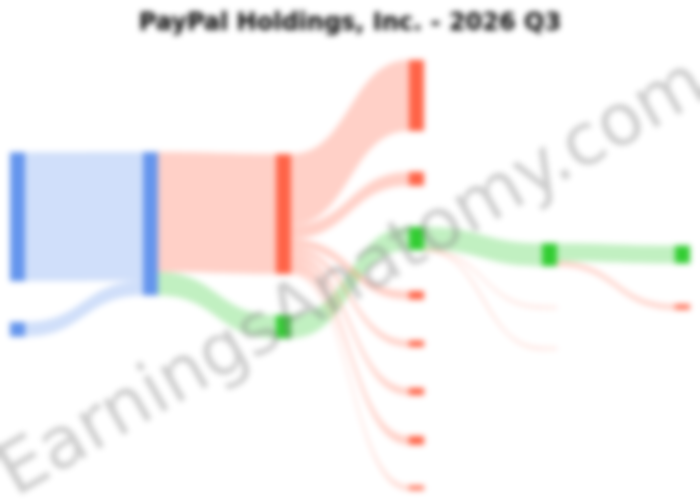
Here is how income flowed from top-line revenue through operating and non-operating lines down to net income during the quarter:
PayPal segments its revenue into two distinct categories:
Geographically, the domestic U.S. market expanded 5.2% to $5.00 billion, while international markets declined 2.2% to $3.58 billion, with no single foreign nation accounting for more than 10% of revenue.
Total operating expenses grew 4.1% to $7.18 billion, outpacing revenue growth. Two primary dynamics drove this change:
Outside of operations, PayPal experienced a drag from "Other income (expense), net," shifting from a gain of $13 million in Q3 2025 to a loss of $28 million. This drop stemmed from increased interest expense following a debt issuance in May 2026, alongside minor paper write-downs on PayPal's portfolio of early-stage strategic fintech and crypto venture holdings.
Quarterly net income fell 14.0% to $1.07 billion (down from $1.25 billion). Yet, diluted earnings per share (EPS) declined by only 3.8%, landing at $1.25 compared to $1.30.
This divergence highlights PayPal’s aggressive capital return program. Over the quarter, PayPal repurchased 27.5 million shares of common stock for $1.52 billion, which helped reduce the diluted share count by more than 10% year-over-year (from 960 million to 858 million shares).
As fintech giants like Block, Adyen, and big tech platforms continue to fight for checkout supremacy, PayPal is leaning into its cost-reduction blueprints and cash generation while modernizing its core branded checkout experience. Although margin pressure and restructuring charges weighed on this quarter’s GAAP bottom line, steady volume growth and reduced credit losses show that PayPal’s underlying processing machine remains powerful.
Last updated: October 28, 2026