Loading blog posts...
April 5, 2026 • 4 min read
For investors tracking the electric vehicle (EV) supply chain, Albemarle Corporation (ALB) serves as a critical bellwether. As one of the world's largest lithium producers, its financial health offers a direct read on the pulse of the battery materials market. However, the company also operates significant Bromine (Specialties) and Catalyst (Ketjen) businesses, adding layers of complexity to its operations.
We are going to dig into the income statement from their latest 10-K filing to unpack how a challenging pricing environment impacted their bottom line and where the company is steering the ship.
The headline story for Albemarle in 2025 is the divergence between how much product they sold versus how much they were paid for it. Total net sales for the year landed at $5.1 billion, a decrease of roughly 4% compared to 2024.
This decline was driven almost entirely by the Energy Storage segment (lithium). Despite a 9% increase in sales volume—indicating robust demand for EV battery materials—net sales for the segment fell 10% to $2.7 billion. This creates a clear picture of the current market: Albemarle is moving record amounts of material, but a steep drop in market pricing for lithium carbonate and hydroxide has compressed the revenue generated from those sales.
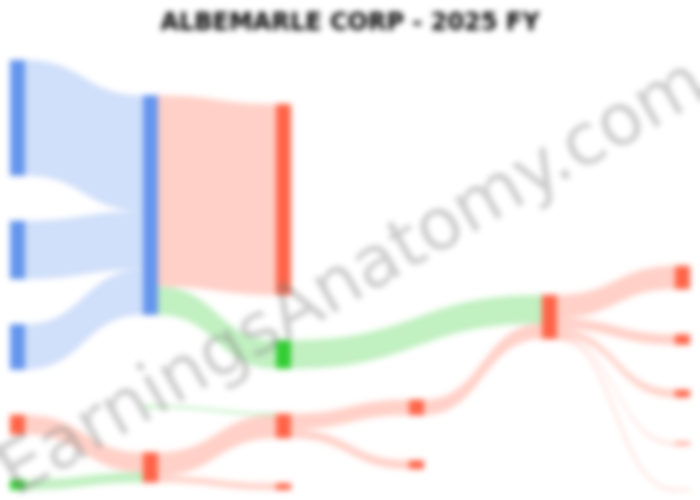
Looking at the flow diagram above, you might notice a distinct improvement in Gross Profit compared to the prior year. In 2025, Albemarle reported a Gross Profit of $669 million (13% margin), a massive jump from just $62.5 million (1.2% margin) in 2024.
This doesn't necessarily mean pricing power returned. Rather, the 2024 figures were heavily weighed down by significant inventory write-offs and restructuring costs embedded in the Cost of Goods Sold (COGS). With those one-time operational hits largely in the rearview mirror, the company's underlying production economics look healthier, even if top-line pressures remain.
Despite the recovery in gross margins, Albemarle still posted a Net Loss attributable to shareholders of $(511 million), or $(5.76) per share. While this is an improvement over the $(1.2 billion) loss in 2024, the company remains in the red due to significant non-cash charges.
Two major items weigh heavily on the income statement this year:
These charges are largely associated with the Ketjen segment (Refining Solutions). Albemarle is currently in the process of divesting this business to focus purely on its core growth engines. While these impairments hurt the reported net income, they are accounting adjustments reflecting the lower valuation of assets held for sale rather than direct cash outflows from operations.
A crucial takeaway from the filing is Albemarle's pivot toward cash preservation. In the resource extraction business, Capital Expenditures (CapEx) are the lifeblood of future growth. However, responding to market conditions, Albemarle slashed its CapEx to $590 million in 2025, down sharply from $1.68 billion in 2024.
By halting construction on expansion projects like Trains 3 and 4 at the Kemerton plant in Australia, management is signaling a strategy of discipline—prioritizing balance sheet health over aggressive expansion until market pricing incentives return.
Albemarle’s 2025 results reflect a company in transition. The underlying demand for lithium remains strong, evidenced by rising volumes. However, like competitors SQM and Ganfeng Lithium, Albemarle is at the mercy of commodity pricing cycles. By streamlining costs, reducing CapEx, and moving to divest the Ketjen business, the company is stripping down to its fighting weight to weather the current low-price environment and position itself for the next upswing in the EV revolution.
Last updated: April 5, 2026
Explore prior quarterly filings, historical revenue breakdowns, and earnings trends.
Visual breakdowns and margin trends from recent public company SEC filings.