Loading blog posts...
June 27, 2026 • 4 min read
Micron Technology, one of the world's largest semiconductor memory and storage manufacturers, sits at the heart of the ongoing artificial intelligence hardware boom. Competing alongside giants like Samsung and SK Hynix, Micron provides the critical DRAM (volatile memory) and NAND (flash storage) chips that power everything from mobile phones to massive cloud data centers. We want to dig into the income statement from their latest 10-Q filing to see how things are going and what we can learn about the current state of the memory market.
The numbers are simply astounding. The memory market is famous for its boom-and-bust cycles, and we are currently witnessing what might be the most lucrative upcycle in the industry's history.
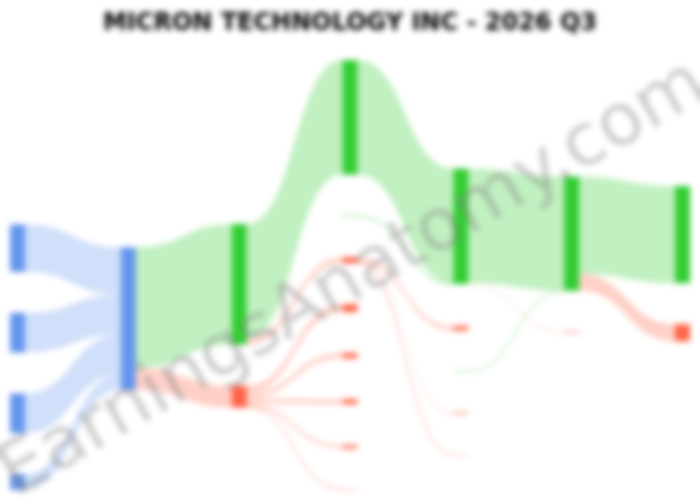
For the quarter ended May 28, 2026, Micron reported a staggering $41.5 billion in total revenue, up 346% compared to the $9.3 billion reported in the same quarter last year.
This astronomical growth is being driven across both major product lines:
The primary catalyst? Artificial Intelligence. The insatiable demand for High-Bandwidth Memory (HBM) and specialized data center solutions is squeezing global supply. Because HBM requires more silicon area and complex packaging than standard memory, it consumes more fabrication capacity. This restricts overall supply growth across the broader memory industry, driving prices into the stratosphere.
With prices surging and manufacturing costs relatively fixed, Micron's profitability has reached unprecedented levels. The company's gross margin expanded to an eye-watering $35.1 billion, or nearly 85% of revenue—a stark contrast to the 38% gross margin seen in the same period last year. Operating income came in at $33.3 billion, translating to a massive 80% operating margin.
Breaking down the business units gives us a clearer picture of where this demand is concentrated:
To sustain this momentum, Micron is pouring cash into capacity expansions. The filing highlights ongoing investments, including the modernization of its Hiroshima facility to support future AI memory production, alongside major manufacturing expansions in Idaho and New York, and a new assembly facility in Gujarat, India.
Interestingly, the filing also reveals a strategic financial move in the AI ecosystem: subsequent to the end of the quarter, Micron purchased non-marketable equity securities in an unnamed "leading AI company." While the company remains unidentified, the investment underscores Micron's commitment to deepening its footprint within the AI value chain.
Micron's latest quarter perfectly illustrates the extreme upside of the semiconductor memory cycle when catalyzed by a paradigm-shifting technology like AI. However, this hyper-cyclicality comes with significant risks. The filing rightly points out that any disruption in demand from a few massive cloud customers, or a faster-than-expected ramp in global manufacturing capacity, could swiftly reverse these pricing trends.
For now, though, Micron is riding an unprecedented wave. As AI models continue to grow in size and complexity, the demand for faster, higher-capacity memory seems virtually boundless, positioning Micron and its peers as the ultimate pick-and-shovel providers of the AI gold rush.
Last updated: June 27, 2026
Explore prior quarterly filings, historical revenue breakdowns, and earnings trends.