Loading blog posts...
October 12, 2026 • 4 min read
Micron's fiscal 2026 annual report is one of the more extraordinary income statements to come out of corporate America in years. Revenue nearly quadrupled, gross margin doubled, and net income rose roughly tenfold. Let's dig into the fiscal 2026 10-K to see what actually drove the numbers — and where the strain shows up elsewhere on the financials.
Micron is the only U.S.-based maker of DRAM (the working memory in servers, PCs, and phones) and one of a handful of NAND flash makers globally, competing mainly with Samsung and SK Hynix in DRAM and with Samsung, SK Hynix/Solidigm, Kioxia, and SanDisk in NAND. Its high-bandwidth memory (HBM) — stacked DRAM bolted to AI accelerators — has become the choke point of the AI buildout.
Revenue hit $133.2 billion, up 256% from $37.4 billion in fiscal 2025. Bit shipments — the industry's volume measure — rose only in the mid-20% range for both DRAM and NAND. The rest was pricing: DRAM average selling prices rose ~180%, NAND ASPs ~200%.
DRAM revenue reached $100.7 billion (up from $28.6 billion), NAND $31.8 billion (up from $8.5 billion).
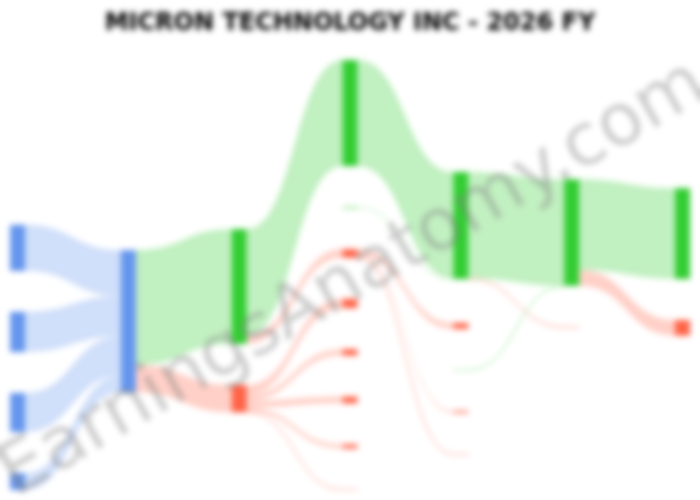
The most striking line isn't revenue — it's cost of goods sold, which rose just 14%, from $22.5 billion to $25.7 billion, even as bits shipped grew 25%+. Memory is a business of enormous fixed costs, so once prices move, nearly every incremental dollar falls to the bottom line. Gross margin went from 40% to 81%, and operating margin from 26% to 75%. The $528 million of unallocated cost of goods sold in the diagram is corporate-level manufacturing cost Micron doesn't push down to the business units; it sits alongside $1.9 billion of unallocated operating costs, including a $500 million patent license charge tied to litigation (Micron and Netlist agreed to dismiss all claims in October 2026).
| Business unit | FY26 revenue | Growth | Operating margin | |---|---|---|---| | CMBU (hyperscale cloud, HBM) | $43.1B | +219% | 72% | | CDBU (core data center/OEM) | $37.6B | +420% | 79% | | MCBU (mobile & client) | $36.6B | +209% | 80% | | AEBU (automotive & embedded) | $15.9B | +234% | 71% |
CDBU — sales to OEM server and storage customers — was the fastest grower. More telling is MCBU: revenue tripled on lower bit shipments, because Micron deliberately redirected mobile and client supply toward data center customers. Its operating margin swung from 17% to 80%. That's the clearest evidence of how scarce supply is being rationed.
Net income of $85.0 billion (64% net margin) translated to diluted EPS of $74.33, versus $7.59 last year. But a few items deserve attention:
Micron's own risk factors lead with the obvious: "volatility in average selling prices." An 180% ASP increase is not a new baseline — it's a cycle position. The company is spending aggressively to expand capacity in Idaho, New York, Japan, Taiwan, and India, and the risk list explicitly flags "insufficient customer demand to utilize our increased capacity." The customer prepayments and multi-year agreements are management's answer to that concern.
For now, shareholders won't complain: $100 invested in MU in 2021 was worth $1,298 at fiscal year-end, versus $354 for the Philadelphia Semiconductor Index. The harder question is whether 81% gross margins survive when Samsung and SK Hynix's new capacity arrives.
Last updated: October 12, 2026
Explore prior quarterly filings, historical revenue breakdowns, and earnings trends.