Loading blog posts...
August 4, 2026 • 3 min read
To evaluate how defense contractors are adapting to modern geopolitical demands and shifting military priorities, examining their quarterly financial statements provides crucial visibility. Analyzing the income statement of L3Harris Technologies (NYSE: LHX) allows us to unpack the company's financial health, operational efficiency, and strategic execution. By digging into their latest 10-Q filing, we can extract key insights into how this defense technology prime is expanding its top line and positioning itself within a high-demand defense landscape.
L3Harris is a global aerospace and defense innovator providing mission-critical technologies across space, air, land, sea, and cyber domains. Operating alongside defense heavyweights like Lockheed Martin, RTX, and Northrop Grumman, L3Harris focuses on advanced command-and-control, electronic warfare, space payloads, and missile propulsion systems.
In the second quarter of 2026, L3Harris generated total revenue of $5.9 billion, representing an 8% increase compared to $5.4 billion in Q2 2025. This top-line expansion was driven by ramping production volumes and strong execution across all business segments. Gross profit rose to $1.5 billion, achieving a 25.5% gross margin. This expansion was aided by a $43 million favorable swing in net Estimate at Completion (EAC) adjustments—a contract accounting metric reflecting revised projected costs and revenues on long-term fixed-price contracts.
Operating income reached $654 million (an 11.1% operating margin), culminating in net income of $600 million. After accounting for a $14 million preferred stock deemed dividend, net income available to common shareholders was $586 million, yielding diluted earnings per share (EPS) of $3.13—a notable improvement from $2.44 in Q2 2025.
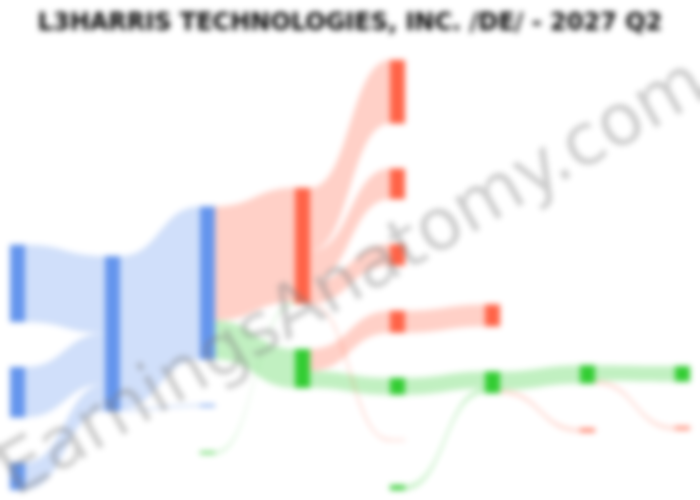
The income statement flow highlights how quarterly revenues translate through operational costs into net profit. Unallocated cost of revenue totaled $15 million for the quarter, representing central corporate headquarters operational expenses that are not assigned directly to any specific business unit.
A key development detailed in the filing is L3Harris's internal segment reorganization, structured around three core operational pillars:
Beyond segment performance, the Q2 10-Q highlights a major strategic deal closed in April 2026: a $1 billion strategic investment by the U.S. Government into L3Harris's Missile Solutions subsidiary via Series A convertible preferred stock and warrants. Net proceeds of $973 million are explicitly earmarked to expand manufacturing infrastructure, accelerate R&D, and ramp up production capacity for critical rocket motors and missile systems. This transaction was recorded on the balance sheet as mezzanine equity (a class of preferred equity with redemption features) and warrant liabilities, creating a non-cash $14 million deemed dividend that reduces net income available to common shareholders.
Supported by a total contractual backlog of $42.0 billion and cash reserves of $1.5 billion, L3Harris enters the second half of 2026 with strong momentum. However, like its peers RTX and Lockheed Martin, the company faces ongoing operational risks, including supply chain constraints, fixed-price contract cost inflation, and reliance on federal budget appropriations. As global defense needs grow increasingly complex, L3Harris's targeted capacity expansions and high-margin defense electronics portfolio position it effectively to compete for critical long-term defense programs.
Last updated: August 4, 2026
Explore prior quarterly filings, historical revenue breakdowns, and earnings trends.
Visual breakdowns and margin trends from recent public company SEC filings.