Loading blog posts...
July 24, 2026 • 4 min read
Honeywell's second quarter of 2026 marks a genuine turning point for the industrial giant. The company reported eye-popping earnings—$5.7 billion in net income on $9.7 billion of sales—but the headline numbers are dominated by one-time accounting events tied to its major corporate restructuring. Digging into the latest 10-Q filing allows us to separate operating reality from non-cash accounting gains and understand how Honeywell's business model is evolving.
For context, Honeywell has spent the past year reshaping its corporate structure into focused public entities: it completed the spin-off of Solstice Advanced Materials in late 2025, and on June 29, 2026—the final business day of the quarter—it completed the spin-off of Honeywell Aerospace. What remains, rebranded as Honeywell Technologies, operates as an automation-focused pure play. This filing captures the transitional moment where these shifting pieces converge on a single income statement.
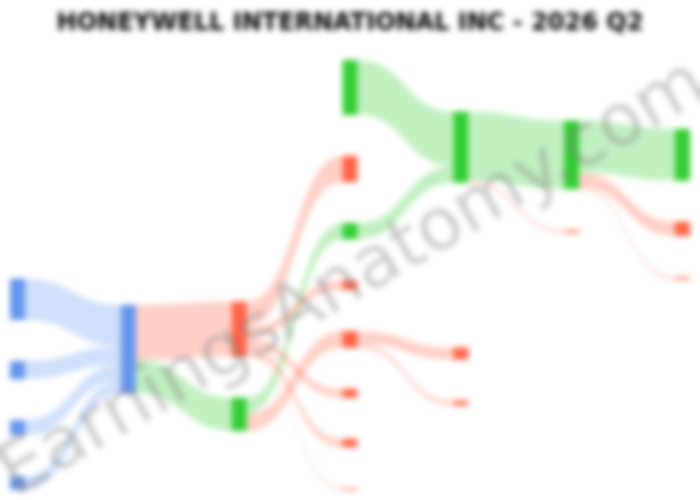
Here is how the quarter's financial results flow from revenue through operating expenses to net profit:
The $194 million of unallocated cost of revenue represents the gap between total cost of products and services sold ($6.07 billion) and the sum of reportable segment costs ($5.87 billion), reflecting corporate-level and non-segment supply costs. Beyond operating items, the primary driver pushing pre-tax income well past total revenue is a massive non-operating gain.
Specifically, Honeywell recorded a $6.63 billion gain on deconsolidation of a subsidiary. That subsidiary is Quantinuum, Honeywell's majority-owned quantum computing venture. Following corporate restructuring ahead of Quantinuum's planned initial public offering, Honeywell relinquished controlling financial interest, deconsolidating the entity and reclassifying its stake as an equity-method investment—valued at $7.26 billion on the balance sheet, with an estimated fair value of $9.4 billion. While this created a massive non-cash gain (worth approximately $15.78 per share after tax), Honeywell now books Quantinuum's net results as an equity loss—amounting to $265 million this quarter.
Additionally, the effective tax rate rose 670 basis points year-over-year, largely due to transaction-related tax costs from the Quantinuum deconsolidation and Aerospace separation.
Underneath the headline figures, Honeywell's core automation segments delivered mixed results. Net sales rose 4% year-over-year to $9.7 billion, supported by pricing gains (+4%) while organic volumes were flat:
Consolidated gross margin dropped 170 bps to 37.6% amid rising labor and direct material costs.
The financing activity reflects the scale of the separation. Honeywell raised $15.8 billion in pre-separation funding while its subsidiaries floated $16.0 billion in Aerospace Senior Notes. Debt tender offers and redemptions resulted in a $241 million year-to-date loss on debt extinguishment, bringing total borrowings to $34.0 billion. On June 25, Moody's revised its credit rating outlook to negative, citing post-split leverage considerations. Six-month operating cash flow dropped to $626 million compared to $1.9 billion in the prior-year period.
This quarter represents a bridge between Honeywell's legacy conglomerate structure and its streamlined future. The $5.7 billion net profit reflects one-time paper gains rather than baseline earnings power. Moving forward, Honeywell Technologies will compete as a pure-play automation provider against peers such as Emerson Electric, Siemens, Schneider Electric, and Rockwell Automation. While Building Automation shows solid momentum, organic margin compression in Process Automation remains a watchpoint. With Aerospace exiting core operations in Q3 and the $1.75 billion acquisition of Johnson Matthey's Catalyst Technologies closed in July, upcoming filings will establish the standalone baseline for the refreshed company.
Last updated: July 24, 2026
Explore prior quarterly filings, historical revenue breakdowns, and earnings trends.
Honeywell Q3 2026 Earnings Analysis: Inside the Conglomerate Restructuring
Oct 22, 2026
Read
Honeywell Q1 2026: Financial Impact of the Aerospace Spin-Off
Apr 24, 2026
Read
Honeywell 2025 10-K Analysis: Aerospace Spin-Off & Restructuring
Mar 27, 2026
Read
Honeywell Q3 2025: Aerospace Drives Growth, One-Time Gain Boosts Profit
Oct 24, 2025
Read