Loading blog posts...
March 27, 2026 • 3 min read
Honeywell International Inc. serves as a barometer for the global industrial economy, with operations touching everything from commercial aviation to sustainable energy. However, the company is currently navigating a pivotal transition period, moving away from its traditional conglomerate structure toward a more focused future.
Let's unpack the numbers from their latest 10-K filing to see how Honeywell performed in 2025 and how it is preparing for its massive restructuring.
The most significant narrative in the 2025 report is the dominance of Aerospace Technologies. As the company prepares to spin off this division into a standalone public company (expected in Q3 2026), the segment is proving its value.
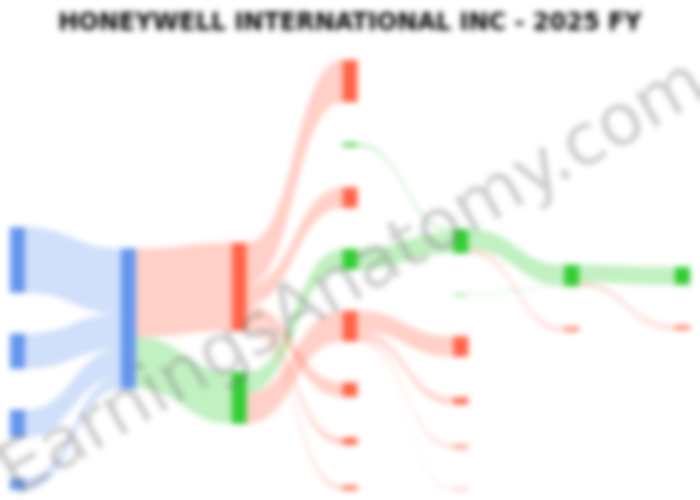
Aerospace generated $17.5 billion in revenue, a 13% increase year-over-year, driven by strong demand in both commercial aviation and defense. This segment now represents nearly 47% of Honeywell's total sales and contributed $4.3 billion in segment profit. For investors, the upcoming spin-off presents a "sum-of-the-parts" opportunity, isolating this high-growth aviation business from the more cyclical industrial units.
Honeywell reported total full-year sales of $37.4 billion, up 8% from 2024. However, looking at the bottom line requires a bit of accounting translation.
Net Income attributable to Honeywell dropped to $4.73 billion, down from $5.71 billion the previous year. Consequently, diluted Earnings Per Share (EPS) fell to $7.36. This decline was not necessarily due to operational failure but rather significant "noise" in the financial statements:
Despite the drop in reported net income, the company’s ability to generate cash remains strong. Operating cash flow actually increased to $6.4 billion, suggesting the core business operations are healthier than the GAAP earnings might imply.
Honeywell's portfolio strategy has been aggressive, utilizing capital to pivot toward high-growth verticals like automation and energy transition.
Building Automation saw sales jump 13% to $7.4 billion, and Energy and Sustainability Solutions (ESS) revenue grew 19% to $3.1 billion. It is important to note that this growth was heavily fueled by the full-year impact of acquisitions completed in 2024, specifically the $4.998 billion purchase of Carrier’s Global Access Solutions and the $1.8 billion acquisition of Air Products' LNG business.
In 2025, Honeywell continued this buying spree, completing the acquisition of CAES Systems for $1.98 billion to bolster its defense offerings. Conversely, the Industrial Automation segment struggled, with sales falling 6% to $9.4 billion. This decline was primarily due to the divestiture of the Personal Protective Equipment (PPE) business, aligning with Honeywell's strategy to exit commoditized markets in favor of high-tech solutions.
Honeywell’s 2025 10-K depicts a company in metamorphosis. While headline earnings were dampened by non-cash impairments, the underlying revenue growth—particularly in Aerospace—remains robust.
For analysts and investors, the key watchpoint moving forward is execution. Management must successfully integrate its recent multi-billion dollar acquisitions while simultaneously disentangling its operations for the upcoming Aerospace spin-off. If navigated correctly, Honeywell aims to emerge as two sharper, more focused entities: an aerospace giant and a specialized industrial automation leader.
Last updated: March 27, 2026
Explore prior quarterly filings, historical revenue breakdowns, and earnings trends.
Honeywell Q3 2026 Earnings Analysis: Inside the Conglomerate Restructuring
Oct 22, 2026
Read
Honeywell Q2 2026: A $6.6B Quantinuum Gain Masks the New Automation Pure-Play
Jul 24, 2026
Read
Honeywell Q1 2026: Financial Impact of the Aerospace Spin-Off
Apr 24, 2026
Read
Honeywell Q3 2025: Aerospace Drives Growth, One-Time Gain Boosts Profit
Oct 24, 2025
Read