Loading blog posts...
April 24, 2026 • 3 min read
The Hartford Financial Services Group, a stalwart in the U.S. insurance market specializing in property and casualty (P&C) coverage, employee benefits, and mutual funds, has released its financial results for the first quarter of 2026. To understand how the company is navigating today's complex economic environment, let's unpack the numbers from their latest 10-Q filing to see what is driving their performance.
The key takeaway? The Hartford kicked off the year with a blockbuster quarter, posting a 36% year-over-year increase in net income available to common stockholders, which rose to $851 million. This strong performance was heavily influenced by a mild catastrophe season and a high-yield investment environment.
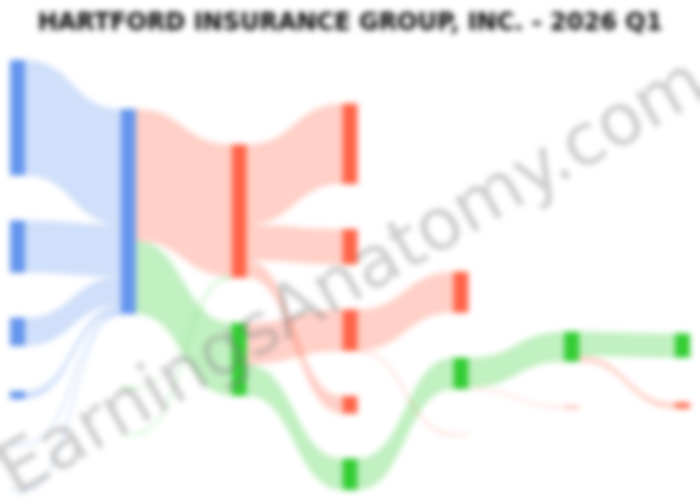
To better visualize how the company generates revenue and where the money goes, the following flow diagram breaks down the Q1 2026 income statement.
The diagram shows revenues flowing from the company's various segments, which are then reduced by costs and expenses to arrive at the final net income.
A significant driver of this quarter's success was a dramatic reduction in catastrophe losses. These events, which include natural disasters like winter storms and hail, cost the company $230 million, less than half of the $467 million in losses from the same period last year.
This had a particularly powerful effect on the Personal Insurance segment, which covers auto and homeowners policies. Thanks to the lower catastrophe claims, this division swung from a $55 million underwriting loss in Q1 2025 to a robust $113 million underwriting gain this quarter. Its combined ratio—a key measure of underwriting profitability where a figure below 100% indicates a profit—improved dramatically from a loss-making 106.1% to a profitable 87.7%.
Another major contributor to the bottom line was the company's investment performance. Net investment income grew 13% to $739 million. This increase was fueled by reinvesting in a higher interest rate environment and a standout performance from limited partnerships and other alternative investments, which generated $75 million in income, nearly double the $39 million from the prior-year quarter.
However, the high-interest-rate environment is a double-edged sword. While it boosts investment returns, it also creates unrealized losses on the existing bond portfolio. This is reflected in the $359 million decrease in Accumulated Other Comprehensive Income (AOCI), which muted the growth in the company's book value per share.
Beyond the headline numbers, the results show a more nuanced picture. While the Personal Insurance segment thrived, the much larger Business Insurance segment, which provides coverage like workers' compensation and general liability, saw its underwriting gain remain flat at $185 million.
Notably, this segment recorded $30 million in unfavorable prior-year development, meaning that claims from previous years came in higher than expected, particularly in general liability. This contrasts with a $83 million favorable development in the same quarter last year. This shift, along with slightly higher operating costs, increased the segment's underlying combined ratio to 89.2% from 88.4%, indicating some pressure on core profitability.
The Hartford's first-quarter results showcase a company capitalizing on favorable investment trends and a quieter-than-expected catastrophe season. The impressive turnaround in Personal Insurance is a clear highlight. However, the slight deterioration in the core results of the Business Insurance segment serves as a reminder of the persistent challenges and claims inflation trends that insurers must continuously navigate.
Last updated: April 24, 2026
Explore prior quarterly filings, historical revenue breakdowns, and earnings trends.
Visual breakdowns and margin trends from recent public company SEC filings.