Loading blog posts...
October 28, 2026 • 3 min read
Examining how supply chain intermediaries navigate shifts in construction and industrial demand offers valuable insight into broader economic trends. A deep dive into the income statement from Graybar Electric Company’s latest Form 10-Q filing reveals how the company is performing, where its momentum originates, and what lessons emerge from its operating model. Founded a century ago and today 100% owned by its active and retired employees, Graybar operates as a leading North American wholesale distributor of electrical, industrial, and automation products. Rather than manufacturing equipment, Graybar acts as an essential supply-chain link, sourcing goods from thousands of manufacturers to support new construction, facility maintenance, repair, and operations (MRO), and infrastructure projects. In the third quarter of 2026, the company posted a new all-time quarterly sales record, crossing the $4.0 billion mark.
Net sales for the third quarter ended September 30, 2026, reached $4,024.7 million, representing a 22.0% year-over-year surge from $3,298.8 million in Q3 2025. Top-line expansion was driven by heightened investment in data centers, grid modernization, electrification, and industrial automation, as well as an active acquisition strategy. During the first nine months of 2026, Graybar invested $265.9 million in cash across three strategic additions—Broken Arrow Electric Supply, American Electric Supply, and Samson Electrical Supply.
Sales growth showed strength across all three of the company’s core customer verticals:
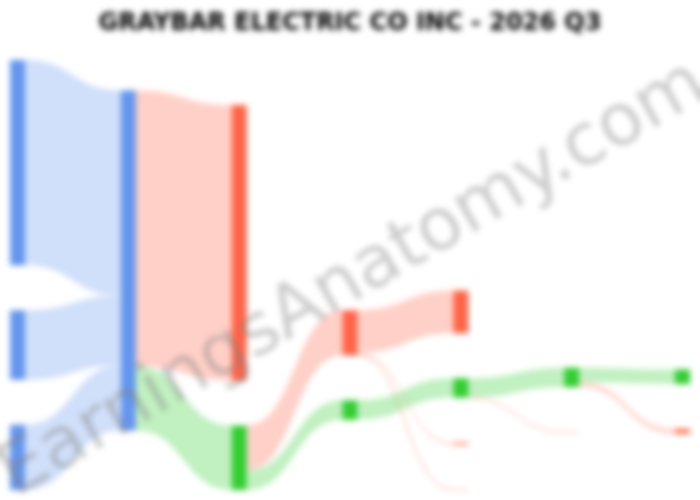
The following flow diagram tracks how Graybar's third-quarter revenue translated into operating earnings and net income:
Gross profit grew 19.3% to $762.1 million. However, gross margin rate contracted by 50 basis points, declining from 19.4% in Q3 2025 to 18.9% in Q3 2026 due to competitive pricing pressures.
Despite this slight margin compression, Graybar achieved substantial operating leverage—a dynamic where revenue increases outpace fixed overhead growth. Selling, general, and administrative (SG&A) expenses rose 12.2% to $504.6 million, reflecting higher compensation, rent, and maintenance, but fell significantly as a percentage of net sales from 13.6% down to 12.5%.
Supported by this cost efficiency, operating income climbed 43.0% to $229.3 million (a 5.7% operating margin, up from 4.9%). After factoring in $1.7 million in net non-operating expenses and a $56.0 million income tax provision, net income attributable to Graybar rose 43.6% to $171.3 million, or $5.22 per share, compared to $119.3 million, or $3.68 per share, in the prior-year period.
Graybar operates in a highly competitive wholesale landscape alongside major global and national distributors such as Wesco International, Rexel, and Sonepar. While secular tailwinds in artificial intelligence infrastructure, renewable energy integration, and manufacturing reshoring continue to bolster demand, distributors face persistent challenges, including raw material commodity volatility, complex logistics networks, and tight pricing competition. Graybar's third-quarter results demonstrate that disciplined cost containment and targeted regional acquisitions can more than offset modest gross margin compression, positioning the employee-owned distributor for sustainable long-term scale.
Last updated: October 28, 2026
Explore prior quarterly filings, historical revenue breakdowns, and earnings trends.
Visual breakdowns and margin trends from recent public company SEC filings.