Loading blog posts...
April 2, 2026 • 4 min read
Citizens Financial Group (CFG), a Providence-based bank holding company and one of the nation's oldest financial institutions, serves a massive footprint across the New England, Mid-Atlantic, and Midwest regions. As a key player in the "super-regional" bank category—competing with the likes of PNC, Fifth Third, and U.S. Bancorp—Citizens’ performance is often viewed as a bellwether for the broader health of U.S. consumer and commercial lending. We are going to dig into the income statement from their latest 10-K filing to see how things are going and what we can learn from their 2025 fiscal year results.
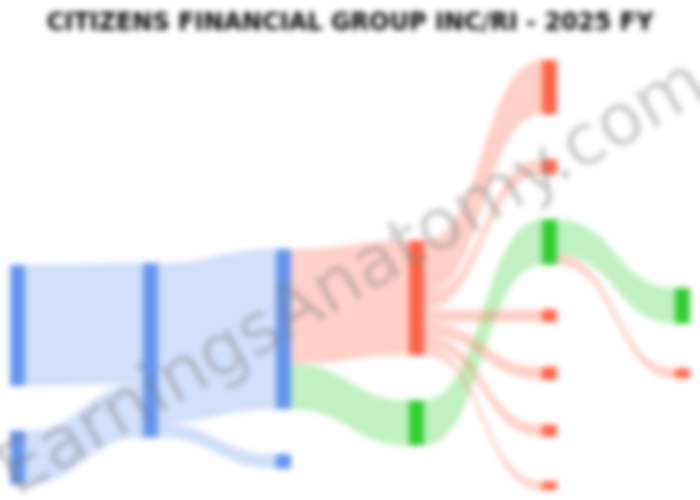
To understand how Citizens converts interest payments and fees into profit, look at the flow of their financials below.
You might notice a negative revenue stream associated with "Other" or unallocated operations in the data. In this filing, the "Other" segment reported a negative net interest income of roughly $897 million. This segment generally houses the bank's treasury activities, wholesale funding costs, and centralized hedging strategies that aren't pushed down to the specific Consumer or Commercial business lines. It effectively acts as a cost center for managing the bank's overall liquidity and interest rate risk.
The headline for 2025 is a robust recovery in profitability. Citizens reported net income of $1.83 billion, a substantial increase from $1.51 billion in 2024. Diluted earnings per share (EPS) climbed to $3.86, up from $3.03 the previous year.
A major driver here was the Net Interest Margin (NIM), which expanded to 2.97% from 2.84%. For those new to banking metrics, NIM is essentially the difference between what a bank earns on loans and what it pays out on deposits. A widening NIM in a stabilizing rate environment suggests Citizens managed its deposit costs effectively while repricing its assets higher.
Management specifically highlighted the build-out of their Private Bank as a key contributor to deposit growth. Average deposits rose by $1.2 billion, signaling that their strategy to court high-net-worth clients is beginning to bear fruit, helping to offset reductions in higher-cost brokered deposits.
Regional banks often struggle to grow revenue outside of lending, but Citizens posted a 10% increase in noninterest income, reaching $2.4 billion.
Two specific areas stood out:
This diversification helps buffer the bank against the cyclical nature of pure lending activities.
The "elephant in the room" for all regional banks recently has been Commercial Real Estate (CRE), particularly office space. Citizens provided some reassuring data here. The Provision for Credit Losses (money set aside for bad loans) decreased to $608 million compared to $687 million in 2024.
The bank noted an "improving loan mix" and reduced CRE exposure. While net charge-offs (debt unlikely to be collected) in CRE were $200 million, this was actually down from $300 million the prior year. The bank is actively managing this risk, with nonaccrual loans (loans no longer generating interest) decreasing by 10% year-over-year.
Citizens Financial Group delivered a strong 2025, marked by an impressive Return on Average Tangible Common Equity (ROTCE) of 11.20%, up from 9.81% in 2024. By controlling credit costs and successfully expanding fee-based businesses like Wealth Management, CFG is positioning itself well. However, like its peers, it continues to face the headwinds of a complex regulatory environment—specifically the looming "Basel III Endgame" capital requirements—and the persistent uncertainties of the commercial real estate market.
Last updated: April 2, 2026
Explore prior quarterly filings, historical revenue breakdowns, and earnings trends.
Citizens Financial Group (CFG) Q3 2026: NII Expansion & Margin Growth
Oct 30, 2026
Read
Citizens Financial (CFG) Q2 2026: Private Wealth Push and Reimagine the Bank
Aug 8, 2026
Read
CFG Q1 2026 Earnings Analysis: Margin Expansion and Capital Markets Boost
May 4, 2026
Read
Citizens Financial (CFG) Q3 2025: Fee Income Surge and Efficiency Gains
Nov 4, 2025
Read