Loading blog posts...
May 4, 2026 • 3 min read
Citizens Financial Group (CFG) is one of the largest regional banks in the United States. Headquartered in Providence, Rhode Island, the bank navigates a highly competitive landscape alongside peers like PNC, Truist, and Fifth Third, offering a mix of retail and commercial banking services. As regional banks continue to adapt to shifting interest rates and economic headwinds, let's unpack the numbers from their latest 10-Q filing to dig into the company's income statement and see what we can learn from their first quarter of 2026.
For the first quarter, Citizens reported a net income of $517 million, a substantial 39% increase from the $373 million earned in the same period last year. This translates to a diluted earnings per share of $1.13, up from $0.77. Let's look at the key drivers behind this strong performance.
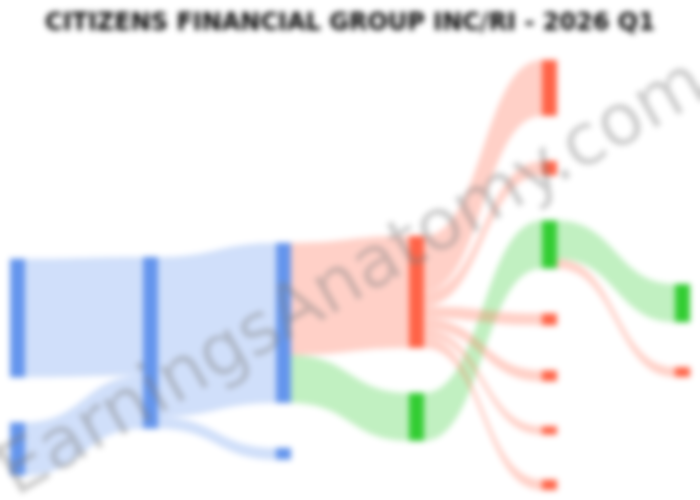
The following flow diagram provides a visual breakdown of Citizens Financial Group's revenue and expenses for the first quarter of 2026, illustrating how the bank generated its net income.
A key factor in CFG's improved profitability was the growth in its Net Interest Income (NII), which rose to $1.56 billion from $1.39 billion year-over-year. NII is the difference between the revenue a bank earns from its lending activities and the interest it pays to depositors. Interestingly, this improvement wasn't just from higher loan income, which grew modestly. A significant contributor was a decrease in interest expense, which fell from $961 million to $858 million. This suggests the bank effectively managed its funding costs, leading to an expansion of its Net Interest Margin (NIM) to 3.14% from 2.89% a year prior.
Beyond its core lending business, CFG saw impressive growth in its fee-based income streams. Noninterest Income jumped 11% to $606 million, driven by two key areas:
This robust performance in fee-generating businesses highlights a successful effort to diversify revenue and reduce reliance on traditional lending. This was partially offset by a 29% decline in mortgage banking fees, reflecting valuation adjustments and lower servicing revenue.
On the expense side, Noninterest Expense rose 5% to $1.38 billion. The primary driver was a 9% increase in salaries and employee benefits. The filing attributes this to hiring for the bank's Private Bank and Private Wealth build-out, as well as variable compensation tied to the strong performance in capital markets. This indicates a strategic investment in talent to support its growing fee-based businesses. A decline in FDIC deposit insurance costs provided a partial offset to the overall expense increase.
In conclusion, Citizens Financial Group's first-quarter results for 2026 paint a picture of a bank that is successfully navigating the current financial environment. By controlling its funding costs to boost net interest income and strategically investing in its high-growth, fee-based segments like capital markets and wealth management, CFG has delivered significant bottom-line growth. This dual focus on margin management and revenue diversification will be critical as it continues to compete in the dynamic regional banking sector.
Last updated: May 4, 2026
Explore prior quarterly filings, historical revenue breakdowns, and earnings trends.
Citizens Financial Group (CFG) Q3 2026: NII Expansion & Margin Growth
Oct 30, 2026
Read
Citizens Financial (CFG) Q2 2026: Private Wealth Push and Reimagine the Bank
Aug 8, 2026
Read
Citizens Financial Group 2025 Review: Rising Margins & Fee Growth
Apr 2, 2026
Read
Citizens Financial (CFG) Q3 2025: Fee Income Surge and Efficiency Gains
Nov 4, 2025
Read