Loading blog posts...
May 4, 2026 • 3 min read
If you're using a smartphone, driving a modern car, or flying on a commercial jet, chances are the complex electronics and systems inside were designed using software from Cadence Design Systems (CDNS). Cadence is a pivotal player in the Electronic Design Automation (EDA) industry, providing the critical tools engineers need to design the chips and systems that power our world. In its first quarter of 2026, Cadence made a bold, landscape-altering move. We're going to dive into the company's first-quarter 10-Q filing to unpack the numbers behind its massive new acquisition and assess the health of its core business.
The biggest story of the quarter was Cadence's massive acquisition of Hexagon's Design and Engineering (D&E) business, a deal valued at approximately $3.1 billion. This strategic purchase brings powerful multiphysics simulation and analysis tools into the Cadence ecosystem, expanding its reach into the aerospace, automotive, and industrial sectors.
The immediate impact on Cadence's balance sheet is stark. To fund the deal, the company's cash and cash equivalents plummeted from $3.0 billion at the end of 2025 to $1.4 billion by the end of March 2026. Simultaneously, Cadence took on $425 million from its revolving credit facility. In place of that cash, the company's assets swelled in other areas: Goodwill skyrocketed by $2.2 billion, and acquired intangible assets jumped by over $1.2 billion. This is a classic case of a company deploying its capital to invest aggressively in future growth.
Despite the enormous cash outlay for the acquisition, Cadence's core operations demonstrated impressive strength. Total revenue for the quarter grew 19% year-over-year to $1.47 billion, while net income rose an even healthier 23% to $336 million.
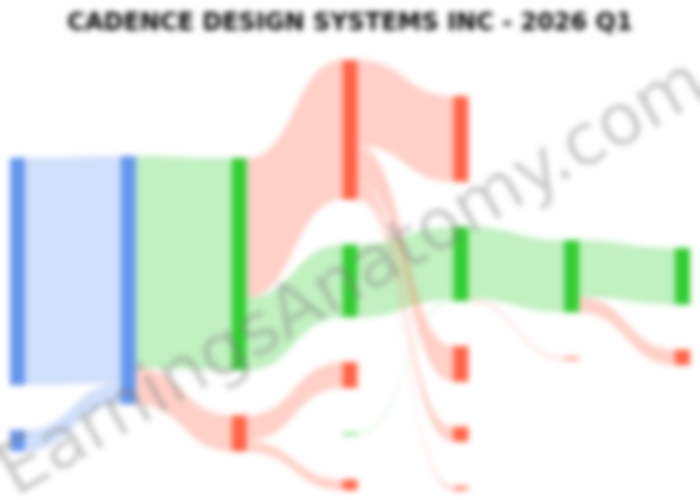
The flow of revenue through the company's costs to its final profit for the quarter is illustrated below.
The company’s revenue remains predominantly recurring, derived from long-term software licenses and maintenance contracts. However, the proportion of recurring revenue dipped slightly to 77% from 82% in the prior year, as "up-front" revenue, often linked to IP and hardware sales, grew to 23% of the total. Geographically, Cadence saw robust growth across the board, with particularly strong performance in China (up 36%) and Japan (up 36%).
Growth and acquisitions naturally bring higher expenses. Total costs and expenses climbed to $1.04 billion from $881 million a year earlier. Key drivers of this increase include:
Cadence has made a transformative bet with the Hexagon D&E acquisition, fundamentally reshaping its balance sheet to chase a larger, more diverse market in system design and analysis. While the immediate financial impact includes a significant reduction in cash and an increase in debt, the company's underlying business continues to fire on all cylinders with strong revenue and profit growth. The challenge for Cadence now is to seamlessly integrate its new assets and prove that this massive investment can deliver sustained, long-term value for shareholders.
Last updated: May 4, 2026
Explore prior quarterly filings, historical revenue breakdowns, and earnings trends.