Loading blog posts...
July 31, 2026 • 3 min read
Cadence Design Systems (CDNS) is a heavyweight in the Electronic Design Automation (EDA) and semiconductor IP space. If you are unfamiliar with the term, EDA refers to the highly specialized software tools that engineers use to design and test the integrated circuits and printed circuit boards that power everything from smartphones to artificial intelligence data centers. In a world increasingly dependent on complex silicon, Cadence is a company selling the vital picks and shovels. Today, our goal is to dig into their latest 10-Q filing to unpack their income statement, see how their financial engine is running in the second quarter of 2026, and extract some insights about their current market position.
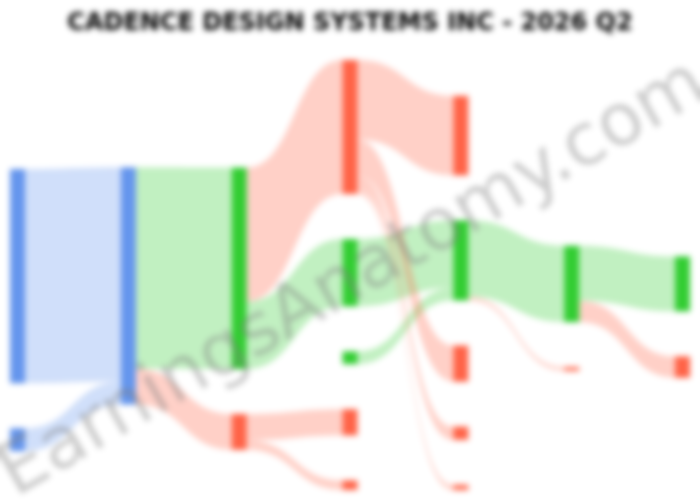
Cadence’s top line continues to impress, with total revenue for Q2 2026 reaching $1.58 billion. This represents robust 24% growth compared to the $1.28 billion reported in the same period last year. The core of this revenue is built on their "Product and maintenance" segment, which brought in $1.43 billion, while their "Services" segment (which includes consulting and custom IP development) accounted for $153.8 million.
A significant driver behind Cadence's expanding footprint is its aggressive acquisition strategy. The filing highlights a massive $3.1 billion acquisition of the Hexagon Design and Engineering Business. This move significantly bolstered their system design and analysis capabilities, adding $1.25 billion in acquired intangible assets to their balance sheet and expanding their addressable market beyond traditional chip design.
While the United States remains Cadence's largest market, accounting for 42% of total revenue ($656.1 million), the most striking geographic data point comes from Asia. Revenue from China skyrocketed by 96% year-over-year, surging from $120.7 million in Q2 2025 to $236.2 million in Q2 2026. As the global race for semiconductor sovereignty heats up, Cadence is clearly benefiting from intense regional investments in localized chip design capabilities.
Software companies are famous for their gross margins, and Cadence is no exception. They achieved a remarkable 84.9% gross margin this quarter, resulting in $1.35 billion in gross profit.
Further down the income statement, net income soared to $367.1 million, a staggering 129% jump from the $160.1 million reported in Q2 2025. However, this year-over-year comparison requires some context. Last year's bottom line was heavily suppressed by a one-time $128.5 million loss related to a contingent liability. Additionally, this quarter's net income was padded by a $71.9 million gain on investments, reflecting favorable adjustments on their equity holdings.
To maintain their competitive moat, Cadence continues to pour money back into innovation. Research and Development (R&D) expenses hit $531.3 million—representing roughly a third of their total revenue and showcasing the sheer cost of staying on the bleeding edge of silicon design.
Cadence operates in a functional duopoly alongside its primary rival, Synopsys, with Siemens EDA also holding significant market share. The EDA market is notoriously sticky; once an engineering team builds a workflow around Cadence or Synopsys tools, the switching costs are incredibly high.
The Q2 2026 filing shows a company firing on all cylinders. By aggressively investing in R&D and executing multi-billion-dollar acquisitions to broaden its system analysis offerings, Cadence is successfully defending its turf while capturing new demand generated by the ongoing global semiconductor boom. Their ability to maintain near 85% gross margins while growing revenue by 24% demonstrates the immense pricing power they hold in the silicon design ecosystem.
Last updated: July 31, 2026
Explore prior quarterly filings, historical revenue breakdowns, and earnings trends.