Loading blog posts...
October 22, 2026 • 4 min read
When looking at defense and national security contractors, CACI International Inc (NYSE: CACI) plays a major role in modernizing federal government operations. Operating alongside industry peers like Booz Allen Hamilton, Leidos, and SAIC, CACI delivers specialized technology and operational talent to the U.S. military, intelligence agencies, and civilian departments. Today, the goal is to dig into the income statement from the company's latest 10-Q filing for the first quarter of fiscal 2027 (ended September 30, 2026) to see how things are going and what we can learn from its financial trajectory.
For the quarter, CACI generated $2.47 billion in total revenue, an 8.2% increase compared to the $2.29 billion recorded in the prior-year period. While organic growth contributed a steady 2.1%—stemming from new contract awards and expanded scope on existing programs—the bulk of the top-line expansion was powered by recent strategic acquisitions, such as space and defense sensor specialist ARKA Group.
CACI breaks its revenue down into two primary business divisions:
Another notable shift appears in how CACI bills its clients. While cost-plus-fee contracts—where the government reimburses costs plus a predetermined fee—remain the largest category at $1.31 billion, fixed-price contract revenue surged 34.4% year-over-year to $821.8 million. Fixed-price contracts carry more execution risk if costs overrun, but they allow contractors to capture higher profit margins when they deliver software and technology solutions efficiently.
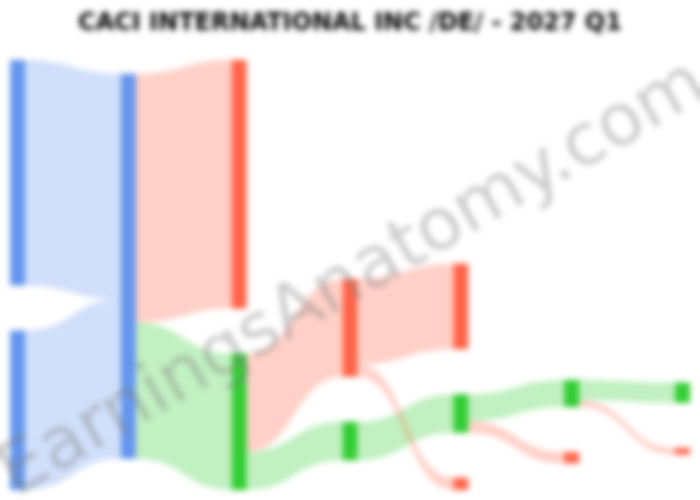
To visualize how this $2.47 billion in quarterly revenue flows through CACI's cost structure down to the bottom line, consider the following breakdown:
Because CACI is shifting toward higher-value technology and fixed-price work, its direct costs (the direct labor, materials, and subcontractor expenses tied to specific contracts) rose just 3.3% to $1.60 billion. That allowed implied gross profit to reach $876.9 million, representing a healthy 35.4% gross margin.
However, expanding through M&A comes with upfront and ongoing costs:
Roughly 97% of CACI's revenue is domestic ($2.40 billion), anchored by the Department of War ($1.35 billion) and the Intelligence Community ($612.0 million). In an environment where CACI competes fiercely with rivals like Leidos and Booz Allen Hamilton for cleared technical talent and multi-year defense contracts, its pivot toward high-margin technology and fixed-price contracts is visibly boosting operating profitability. Going forward, the key challenge for CACI will be smoothly integrating its newly acquired businesses and generating strong cash flows ($161.3 million in operating cash flow this quarter) to pay down debt, all while navigating potential federal budget delays and fierce competition in the national security space.
Last updated: October 22, 2026
Explore prior quarterly filings, historical revenue breakdowns, and earnings trends.
Visual breakdowns and margin trends from recent public company SEC filings.