Loading blog posts...
August 6, 2026 • 3 min read
Analyzing a major property and casualty insurer's financial performance provides valuable insights into how rate discipline, catastrophe trends, and financial markets intersect. Let's dig into the income statement from Allstate's latest 10-Q filing to see how the company performed in the second quarter of 2026 and extract key takeaways on its operating execution and capital strategy.
Total revenues reached $18.60 billion in Q2 2026, an 11.8% increase from $16.63 billion in Q2 2025. Net income attributable to Allstate surged to $3.27 billion ($12.51 per diluted share), up from $2.11 billion ($7.76 per diluted share) in the prior-year period.
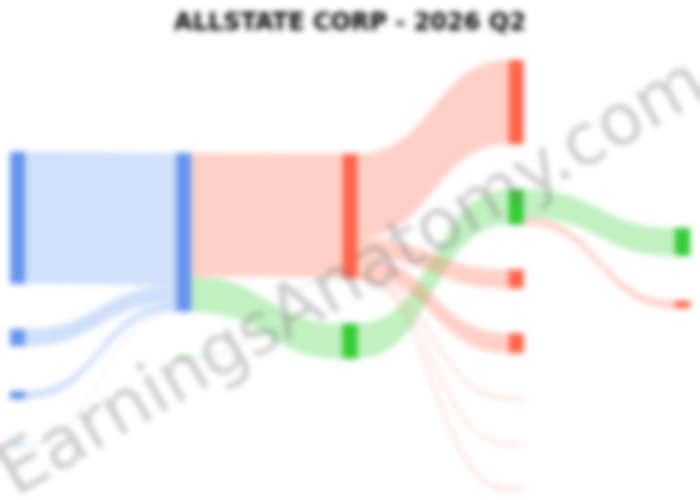
The diagram below illustrates how Allstate generated its revenue and managed operating costs to produce net income during the quarter:
In the revenue flow, unallocated revenue of $2.01 billion consists primarily of net investment income, net gains on investments and derivatives, and consolidation eliminations that are managed at the corporate level rather than assigned directly to operating business divisions.
The primary engine driving profit expansion was the core Allstate Protection segment, which provides personal auto, homeowners, specialty lines, and commercial insurance. Property-liability earned premiums rose 4.0% year-over-year to $14.92 billion.
Operational execution showed marked improvement across key metrics:
Beyond underwriting, investment performance provided significant earnings tailwinds:
In addition, Protection Services—comprising consumer protection plans (like SquareTrade), roadside assistance, dealer services, and telematics provider Arity—generated $961 million in revenue and $53 million in adjusted net income. Backed by $6.20 billion in operating cash flow over the first six months, Allstate returned $1.33 billion to common shareholders during the quarter through $1.05 billion in open-market share buybacks and $277 million in dividends.
Allstate's second-quarter performance demonstrates how rate adjustments, moderate weather losses, and strong market returns can align to drive substantial profitability. As the insurer transitions from restoring margins to expanding policy count in a competitive market alongside peers like Progressive and State Farm, maintaining strict underwriting standards and disciplined capital management will remain central to sustaining these gains.
Last updated: August 6, 2026
Explore prior quarterly filings, historical revenue breakdowns, and earnings trends.