Loading blog posts...
May 4, 2026 • 4 min read
As a utility providing electricity and natural gas across Iowa and Wisconsin, Alliant Energy (LNT) operates in a world of massive infrastructure projects and complex regulations. In its first-quarter 2026 financial filing, the company details how it's navigating rising costs and deploying capital to modernize its grid, offering a clear picture of the opportunities and challenges in the utility sector today. Let's unpack the income statement to see how things are going and what we can learn from their latest results.
Alliant Energy saw its total revenues climb to $1.18 billion in the first quarter of 2026, up from $1.13 billion in the same period last year. This growth was driven by both its electric and gas segments. The majority of revenue, about $888 million, came from the electric utility, with gas contributing $271 million.
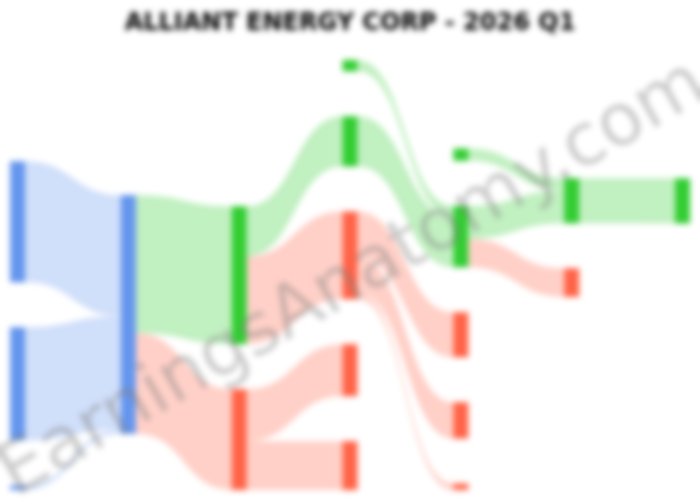
This flow diagram provides a visual breakdown of how the company's revenues are converted into profit.
A key driver for the revenue increase was the recovery of higher costs and approved rate adjustments to fund infrastructure investments, particularly in its Wisconsin Power and Light (WPL) segment. While higher revenue is positive, it's important to note that a significant portion, especially on the gas side, reflects the pass-through of higher fuel costs, which doesn't directly translate to higher profits.
The story of the quarter is not just about revenue, but also about the rising costs associated with growth and modernization. Total operating expenses jumped from $871 million to $935 million year-over-year. This increase led to a slight dip in operating income, which landed at $249 million compared to $257 million in Q1 2025.
Two key expense items tell the story:
These figures align with Alliant's broader strategy. The company is in the midst of a multi-billion dollar capital expenditure plan focused on renewables, energy storage, and grid upgrades to meet growing demand, including from new data centers in its service area.
Despite lower operating income, Alliant Energy reported a higher net income of $224 million ($0.87 per share), compared to $213 million ($0.83 per share) in the prior-year quarter. How did profit grow when operating income fell? The answer lies below the operating income line.
The two main contributors were:
Alliant Energy's first-quarter results paint a picture of a classic regulated utility in transition. The company is successfully growing its revenue base through approved rate increases tied to its substantial investments in modernizing its grid and generation fleet. However, these investments come with higher depreciation and financing costs that pressure operating margins.
The growth in net income, supported by tax benefits and accounting conventions like AFUDC, shows the company is effectively managing its finances through this investment-heavy period. For investors, the key takeaway is that Alliant is executing on its long-term strategy to prepare for a more electrified future, but it's a path that requires navigating the persistent challenge of rising costs.
Last updated: May 4, 2026
Explore prior quarterly filings, historical revenue breakdowns, and earnings trends.
Visual breakdowns and margin trends from recent public company SEC filings.