Loading blog posts...
August 2, 2026 • 4 min read
Air Products' fiscal third-quarter numbers look like two entirely different companies stapled together. On the surface, the industrial gas giant just posted a $1.44 billion net loss and a jaw-dropping negative 66.3% operating margin. Underneath, sales grew, margins expanded, and adjusted earnings hit a record. Let's dig into the Q3 FY2026 10-Q to see how both things can be true at once.
For the uninitiated: Air Products (NYSE: APD) is one of the world's largest industrial gas companies, producing oxygen, nitrogen, argon and hydrogen either through pipelines to on-site customers (refineries, steel mills, chemical plants), or in packaged/bulk "merchant" form. Its main rivals are Linde and Air Liquide, with Nippon Sanso a distant third.
The quarter's headline is a $2,907.4 million pre-tax charge for "business and asset actions." This stems from management's July decision not to proceed with the Louisiana Clean Energy Complex (LCEC) — a multi-billion-dollar blue hydrogen and ammonia project that no longer cleared the company's return hurdles. The charge splits into $2,210.6 million of asset write-downs and $696.8 million of accrued exit costs (contract terminations and asset retirement obligations), of which none has been paid in cash yet.
This is not a one-off habit. Combined with FY2025's project exits, cumulative charges now total $6,565.8 million — Air Products has written off roughly $6.6 billion of the clean-hydrogen ambitions built under prior leadership. Retained earnings dropped from $17.6 billion in September to $16.3 billion, and total shareholders' equity fell to $13.9 billion.
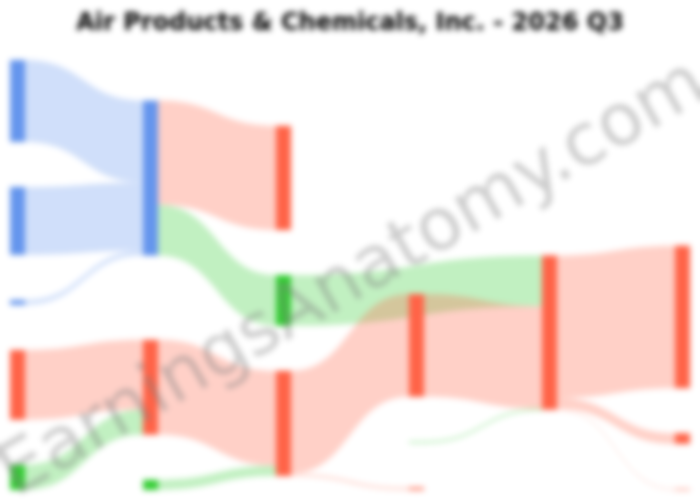
In the flow above, the "Other income (expense), net" line of $14.9 million appears as a credit against operating expenses — it sits above the operating income line in Air Products' income statement, so it reduces total costs rather than adding to them.
Excluding project exits, this was a genuinely good quarter:
By region, Asia was the standout — sales up 9% and operating income up 18%, with margin jumping 210bp to 28.9%. Americas grew income 6%. Europe was the laggard: sales rose 6% but purely on currency and energy pass-through, as volumes actually fell 2%, and margin slipped 90bp.
The income statement understates how Air Products makes money. Equity affiliates' income of $205.2 million — up 22% — sits below operating income entirely. That's profit from joint ventures the company doesn't consolidate. The clearest example: the Middle East and India segment booked just $34.8 million of sales but $101.1 million of equity affiliate income, mostly from Saudi Arabian ventures. Judging that segment on revenue alone would be badly misleading.
Second, interest expense fell 20% to $49.4 million — but interest incurred actually rose to $169.8 million. The gap is $120.4 million of capitalized interest (interest rolled into the cost of assets under construction rather than expensed). That's 71% of interest costs deferred to the balance sheet, a tailwind that shrinks as projects finish or get cancelled.
Cash generation is improving sharply: nine-month operating cash flow of $3.31 billion versus $2.00 billion a year ago, while capital spending dropped to $2.65 billion from $4.00 billion. That's the capital discipline story management has been selling since the 2025 proxy fight — fewer moonshots, more return on invested capital.
The trade-off is that Air Products has now surrendered much of its first-mover position in green and blue hydrogen just as Linde and Air Liquide pursue more incremental, contracted projects. What remains is a high-quality, high-margin industrial gas franchise — with the $8.1 billion NEOM green hydrogen complex still on the books as the big outstanding bet.
Last updated: August 2, 2026
Explore prior quarterly filings, historical revenue breakdowns, and earnings trends.