Loading blog posts...
February 25, 2026 • 3 min read
Aflac, a name synonymous with supplemental health and life insurance in both the U.S. and Japan, recently released its financial results for the 2025 fiscal year. To understand the company's performance, let's dive into the details of their comprehensive 10-K filing. While the headline net earnings number shows a significant drop, a closer look at the underlying operations reveals a story of resilience in the U.S. and strategic navigation in its largest market, Japan.
For the fiscal year ending December 31, 2025, Aflac reported net earnings of $3.6 billion, a sharp decline from the $5.4 billion earned in 2024. However, much of this drop can be attributed to market volatility. The company swung from over $1.2 billion in net investment gains in 2024 to $572 million in net investment losses in 2025.
To smooth out such market-related fluctuations, Aflac provides a non-GAAP (Generally Accepted Accounting Principles) measure called "adjusted earnings." On this basis, the company’s performance was much more stable, coming in at $4.0 billion for 2025, just slightly below the $4.1 billion from the previous year. This indicates that the core insurance business remained on a steady footing.
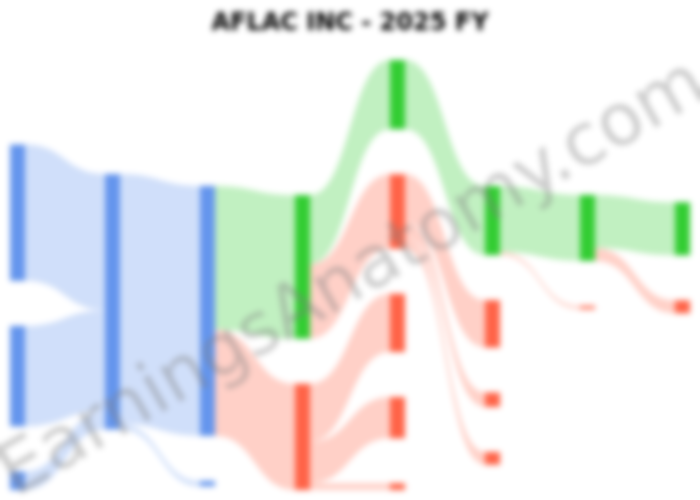
The flow of revenue and expenses for the full year is illustrated in the diagram below.
Aflac's performance is best understood by looking at its two primary segments: Aflac Japan and Aflac U.S.
Aflac Japan, the company's largest segment, saw its pretax adjusted earnings decrease by 2.7% in local currency terms to ¥514 billion (approximately $3.4 billion). The filing points to lower investment income and a slight dip in net earned premiums as the main drivers. The massive concentration of business in Japan remains a key risk factor for Aflac, exposing it to the country's economic conditions, interest rate environment, and currency fluctuations.
However, it wasn't all headwinds in Japan. New annualized premium sales, a key indicator of growth, surged by an impressive 16.0% on a yen basis. This growth was fueled by strong sales of a new cancer insurance product, Miraito, and a savings-type product called Tsumitasu, demonstrating effective product innovation and market traction.
Aflac U.S. delivered a steady and encouraging performance. Pretax adjusted earnings were essentially flat at $1.4 billion. More importantly, the U.S. segment saw continued growth momentum, with net earned premiums rising 2.9% to $6.0 billion. New annualized premium sales also grew by 3.0% to nearly $1.6 billion, largely driven by the company's group products.
Despite the challenging investment environment, Aflac remained committed to returning capital to its shareholders. In 2025, the company:
This aggressive capital return strategy signals management's confidence in the company's long-term cash-generating capabilities. As of the end of the year, Aflac still had authorization to repurchase an additional 114.3 million shares.
Aflac's 2025 results paint a picture of a company with a resilient core. While investment losses impacted the bottom line, the underlying insurance operations performed steadily, with the U.S. segment showing solid growth and new products gaining traction in Japan. The company's ability to navigate the unique challenges of the Japanese market—from low interest rates to currency risk—while capitalizing on growth in the U.S. will be critical to its future success. The strong sales figures in both major markets provide a positive signal as Aflac moves into 2026.
Last updated: February 25, 2026
Explore prior quarterly filings, historical revenue breakdowns, and earnings trends.
Visual breakdowns and margin trends from recent public company SEC filings.