Loading blog posts...
September 23, 2026 • 3 min read
Let's unpack the numbers from Adobe's latest 10-Q filing to see how the creative software giant is navigating the rapidly evolving tech landscape and what we can learn from its income statement. For those unfamiliar, Adobe is the dominant software-as-a-service (SaaS) player behind industry standards like Photoshop, Illustrator, Acrobat, and a massive suite of enterprise marketing tools. As the tech world pivots hard into generative AI, we want to look under the hood to see if Adobe's substantial product investments are translating into real financial results.
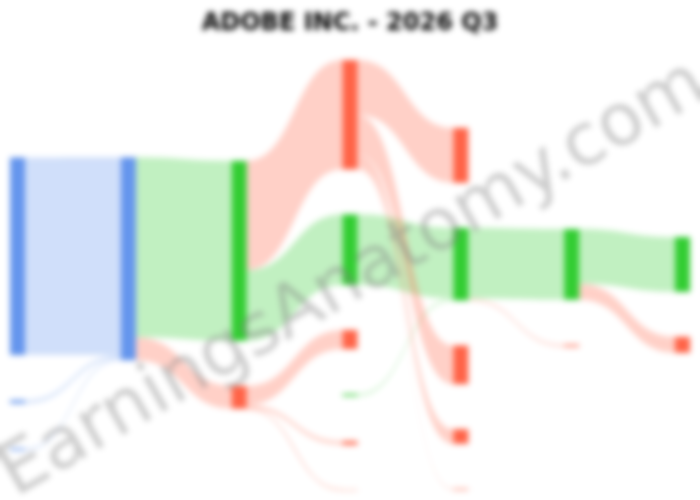
Adobe reported a record $6.76 billion in total revenue for the quarter ended August 28, 2026, marking a solid 13% increase year-over-year. The engine behind this growth continues to be Adobe's massive recurring revenue model. Subscription revenue accounted for an overwhelming 97% of total revenue, coming in at $6.58 billion (up 14% YoY).
Diving deeper into the subscription segments, the Creative & Marketing Professionals customer group brought in $4.65 billion, while the Business Professionals & Consumers group contributed $1.91 billion, growing 13% and 16% respectively. The remaining 3% of revenue came from Services & Other ($111 million) and Product sales ($67 million).
This top-line momentum is heavily tied to Adobe's successful rollout of generative AI capabilities. AI-first annual recurring revenue (ARR) has reportedly crossed the $650 million mark, driven by aggressive adoption of Adobe Firefly and new Acrobat AI Assistant features that convert dense documents into digestible audio and visual formats.
One of the most remarkable aspects of Adobe's financial profile is its gross margin. Cost of revenue was just $763 million (largely tied to hosting and data center costs), leaving the company with a staggering $6.0 billion in gross profit—an 88.7% gross margin. This high profitability is a hallmark of mature, scalable SaaS businesses.
However, remaining the industry standard isn't cheap. Operating expenses jumped 15% year-over-year to $3.64 billion. A significant chunk of this was driven by Research and Development (R&D) costs, which spiked 18% to $1.29 billion. This aggressive R&D spending highlights the compute-intensive nature of building out new AI capabilities and large language models. Sales and Marketing (S&M) remained the largest expense category at $1.83 billion, underscoring the massive budget required to acquire and retain enterprise clients globally.
After accounting for all expenses and a $530 million tax bill, Adobe posted a net income of $1.83 billion, up 3% from the same quarter last year. This equates to a very healthy 27% net profit margin.
Adobe is aggressively returning capital to its shareholders. Over the first nine months of fiscal 2026, the company repurchased 26.1 million shares in the open market, deploying roughly $6.8 billion in cash.
The quarter also sets the stage for a massive organizational shift. It was recently announced that long-time CEO Shantanu Narayen will be handing the reins to Anil Chakravarthy in December 2026. With interim CFO Steve Day currently managing the financials, this leadership transition comes at a critical inflection point for the company.
Adobe's Q3 2026 results show a highly profitable tech behemoth successfully monetizing its AI investments. But the competitive landscape is fierce. Upstarts like Canva are gunning for the lower-end creative market, while enterprise software is broadly shifting from passive tools to "agentic" software that completes tasks autonomously. Adobe’s core challenge moving forward will be justifying its premium pricing and converting its booming freemium user base—now boasting over 1 billion monthly active users—into paying subscribers. Given its formidable gross margins and relentless R&D spending, Adobe seems well-equipped for the battle.
Last updated: September 23, 2026
Explore prior quarterly filings, historical revenue breakdowns, and earnings trends.
Adobe Q2 FY2026: Record $6.62B Revenue Meets the AI Crossroads
Jun 15, 2026
Read
Adobe Q1 2026 Financial Analysis: Strong Subscriptions Meet Rising Costs
Mar 25, 2026
Read
Adobe FY2025 Analysis: Margins Expand After Figma Deal Termination
Jan 16, 2026
Read
Adobe Q3 2025 Analysis: Subscription Growth Drives $8.9B Stock Buyback
Sep 25, 2025
Read