Loading blog posts...
June 15, 2026 • 4 min read
Adobe's latest quarterly report lands at an interesting moment. The maker of Photoshop, Illustrator, Acrobat, and the Firefly generative-AI suite is delivering record revenue while the market openly debates whether AI is a tailwind for the creative-software giant—or an existential threat. Let's dig into the income statement from Adobe's fiscal Q2 2026 10-Q to see how the business is actually performing beneath the AI headlines.
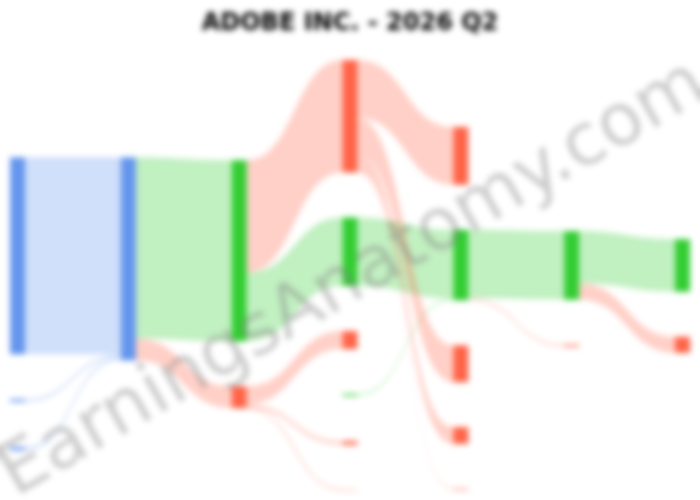
For the quarter ended May 29, 2026, Adobe posted total revenue of $6.62 billion, up 13% from $5.87 billion a year earlier. Here's how that revenue flowed through to the bottom line:
The story here is subscription dominance. Subscription revenue hit $6.42 billion, up 14% year-over-year and representing a striking 97% of total revenue. Adobe's legacy "Product" (perpetual license) and "Services and other" lines are now rounding errors—$89 million and $113 million respectively, with services actually declining 22%.
Adobe reports as a single segment but breaks subscriptions into two customer groups:
The faster growth in the consumer group reflects Adobe's "freemium" push—getting AI tools into more hands now to monetize later. Management also flagged that total Annualized Recurring Revenue (ARR)—the run-rate value of recurring subscriptions—reached $27.10 billion, up 12.5%, and that AI-first ARR has crossed the $500 million mark, roughly tripling year-over-year. Remaining performance obligations (contracted revenue not yet recognized) grew 13% to $22.27 billion, a healthy forward-looking signal.
Gross profit rose to $5.90 billion, an impressive 89% gross margin—the hallmark of a software business at scale. The most notable pressure came below the gross-profit line.
Operating expenses jumped 17% to $3.67 billion, outpacing revenue growth. The standout was General & administrative, which surged 45% to $546 million. The filing attributes this to a few unusual items:
Sales & marketing also climbed 16% to $1.88 billion as Adobe leans into promoting its AI products. The net effect: operating income grew just 6% to $2.24 billion, meaningfully slower than the 13% top-line growth—a sign Adobe is spending heavily to defend and extend its franchise.
Net income was $1.71 billion, essentially flat versus $1.69 billion last year, despite higher operating income. The culprit is taxes: the effective tax rate jumped to 24% from 20%, pushing the provision up 28% to $526 million. That tax drag, combined with elevated G&A, neutralized the revenue gains at the net-income level.
One bright spot for per-share metrics: diluted EPS rose to $4.25 from $3.94 (+8%), outpacing net income growth purely because Adobe shrank its share count. The company repurchased $4.59 billion of stock in the first six months and has burned through roughly 16.6 million shares. Share count fell from 429 million to 402 million diluted shares year-over-year—a textbook example of buybacks doing the EPS heavy lifting.
The biggest strategic move in the filing is the $1.87 billion Semrush acquisition, which added $1.25 billion of goodwill and $582 million of intangibles to the balance sheet. Semrush is a 17-year-old SEO and competitive-intelligence platform, and Adobe's logic is clear: as AI chatbots increasingly mediate how consumers discover brands, Adobe wants to own "brand visibility" in AI-driven search—pairing content creation (Firefly, Express) with discoverability analytics.
The deal helps explain other balance-sheet shifts: cash fell to $4.92 billion (from $5.43 billion), goodwill rose to $14.04 billion, and working capital swung to negative $3.0 billion, largely because $1.35 billion of senior notes are now classified as current. Operating cash flow remains robust at $5.12 billion year-to-date (+10%), so liquidity isn't a concern.
Adobe continues to be a cash-generating machine with near-90% gross margins and double-digit recurring-revenue growth. Yet the quarter exposes the central tension: revenue is growing, but flat net income, rising operating costs, a goodwill write-down, and a fresh legal reserve suggest the cost of staying ahead is climbing. With rivals like Canva, generative-AI upstarts, and even foundation-model providers nibbling at the edges of creative software, Adobe is spending aggressively—on M&A, AI development, and marketing—to prove that AI feeds its business rather than eats it. The Semrush bet and tripling AI-first ARR show management's conviction; whether investors share it remains the open question.
Last updated: June 15, 2026
Explore prior quarterly filings, historical revenue breakdowns, and earnings trends.
Adobe Q3 2026 10-Q: Generative AI Powers Record SaaS Revenue
Sep 23, 2026
Read
Adobe Q1 2026 Financial Analysis: Strong Subscriptions Meet Rising Costs
Mar 25, 2026
Read
Adobe FY2025 Analysis: Margins Expand After Figma Deal Termination
Jan 16, 2026
Read
Adobe Q3 2025 Analysis: Subscription Growth Drives $8.9B Stock Buyback
Sep 25, 2025
Read