Loading blog posts...
May 9, 2026 • 3 min read
AbbVie, a titan in the pharmaceutical industry, has been closely watched as it navigates the patent expiration of Humira, once the world's best-selling drug. The company's strategy has been to pivot to a new generation of treatments to offset the inevitable revenue decline. To see how this transition is unfolding, let's unpack the numbers from their latest 10-Q filing for the first quarter of 2026 and dig into the income statement.
AbbVie reported total net revenues of $15.0 billion for the quarter, a healthy 12.4% increase from $13.3 billion in the same period last year. This top-line growth is particularly impressive given the continued decline of Humira, whose sales plummeted by nearly 40% to $688 million.
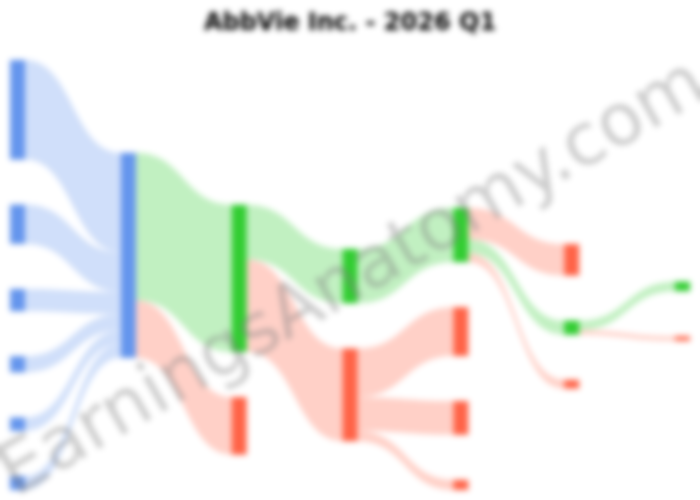
The visual below breaks down how AbbVie's revenue flows through its costs and expenses to arrive at its net earnings for the quarter.
The heroes of this growth story are clearly from the company's Immunology and Neuroscience portfolios.
Together, these two immunology drugs generated over $6.6 billion, more than making up for Humira's decline. The Neuroscience division also showed remarkable strength, with products like Botox Therapeutic, Vraylar, and Ubrelvy all posting double-digit growth. This demonstrates a successful diversification of revenue streams, reducing the company's reliance on a single blockbuster.
While revenues painted a rosy picture, the bottom line tells a more complex story. AbbVie's Net Earnings attributable to the company fell sharply to $695 million, down from $1.3 billion in Q1 2025. So, where did the money go?
Two key areas stand out:
Investment in the Future: Research and Development (R&D) expenses climbed 20% to $2.5 billion. This includes advancing key pipeline assets, such as initiating a Phase 3 trial for ABBV-706 in small cell lung cancer. Furthermore, expenses for Acquired In-Process R&D (IPR&D) and milestones more than doubled to $744 million, reflecting AbbVie's strategy to acquire promising external innovation.
Non-Operating Expenses: The largest impact came from a line item called "Other expense, net," which ballooned to $2.3 billion. The filing reveals this was almost entirely driven by a non-cash charge of nearly $2.4 billion related to the change in fair value of "contingent consideration." In simpler terms, this is an accounting adjustment related to the estimated future payments AbbVie owes for companies it has previously acquired. As the probability of success for the acquired drugs increases, the expected payout liability also rises, creating a significant expense on the income statement.
AbbVie's Q1 2026 results showcase a company in a critical, and so far successful, transition. The strategy to replace Humira's revenue is working, with Skyrizi and Rinvoq leading a strong portfolio of growth products. However, this growth comes at a cost. The company is heavily investing in its pipeline through both internal R&D and acquisitions, which, along with non-cash accounting charges, is putting significant pressure on short-term profitability. This financial profile is characteristic of a company building its next chapter of growth, a dynamic that investors will continue to monitor closely.
Last updated: May 9, 2026
Explore prior quarterly filings, historical revenue breakdowns, and earnings trends.