Loading blog posts...
July 22, 2026 • 4 min read
When a household name like 3M reports, the headline numbers rarely tell the whole story. On the surface, second-quarter 2026 operating income fell to $984 million from $1.14 billion a year ago—but net income actually jumped 29%. Let's dig into 3M's latest 10-Q filing to untangle what's really driving the business, and why management felt confident enough to raise full-year guidance.
For the uninitiated, 3M is a sprawling industrial-technology conglomerate best known for Post-it Notes, Scotch tape, and thousands of adhesives, abrasives, films, and safety products. It now operates in three reportable segments—Safety and Industrial, Transportation and Electronics, and Consumer—following the 2024 spin-off of its healthcare business into a separate company called Solventum.
Net sales rose 2.4% to $6.5 billion in the quarter. But that GAAP figure understates the underlying momentum. On an organic basis (stripping out currency and divestitures), and adjusting for the exit from PFAS "forever chemical" manufacturing, sales grew a healthy 5.4%.
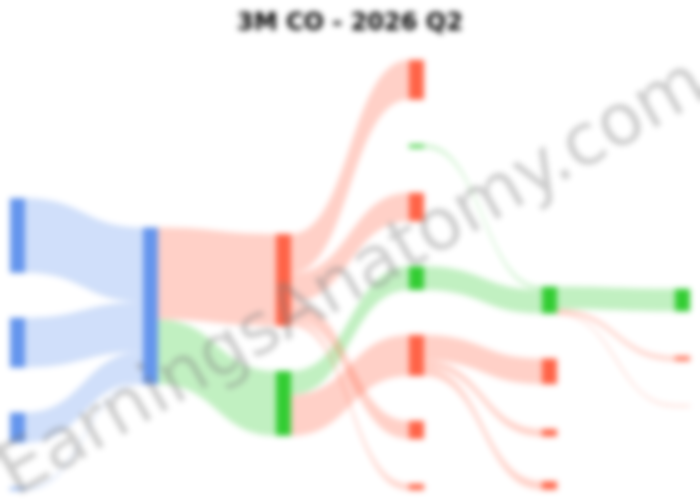
Here's how the quarter flowed from revenue to the bottom line:
You'll notice a small $96 million "Corporate" revenue line and $249 million of unallocated cost of sales. This "Corporate" bucket captures commercial activity with Solventum and the residual operations of 3M's former healthcare business that weren't spun off, plus transition service agreements. It shrank sharply from $273 million a year ago as those arrangements wind down.
The segment story is a tale of two markets:
The apparent contradiction comes down to two big swing items buried below the operating line.
First, operating income was dragged down by a $336 million loss on business divestitures and $100 million in "transformation" restructuring costs—both one-time in nature. That's why 3M's adjusted operating margin was a robust 24.9%, versus the 15.1% GAAP figure.
Second, and more interesting, is the line called "Solventum ownership – change in value." 3M retained a stake in Solventum common stock after the spin-off, and it must mark that holding to market each quarter. This quarter, Solventum shares rose enough to generate a $303 million non-cash gain, flipping "other expense" of $217 million a year ago into $136 million of income this quarter. That single item explains most of the earnings swing—and it's a reminder that a chunk of 3M's reported profits currently rides on the stock price of a company it no longer controls (its remaining stake was valued at roughly $2 billion on the balance sheet).
The effective tax rate also fell to 16.3% from 26.6%, further boosting net income to $933 million, or $1.78 diluted EPS (up from $1.34). On an adjusted basis, EPS was $2.40.
3M remains an aggressive buyer of its own stock, repurchasing $3.0 billion worth of shares in the first half of 2026 and paying $813 million in dividends. That share count reduction (down ~18 million shares year over year) is itself a tailwind to EPS.
The filing devotes pages to PFAS litigation—the "forever chemicals" cases spanning water systems, personal injury, and dozens of state attorneys general actions, plus ongoing Combat Arms earplug and respirator liabilities. This quarter absorbed $183 million in net litigation and PFAS-exit costs. These legal contingencies remain the single biggest known risk to the investment case, and 3M explicitly warns that Aearo earplug liabilities could exceed recorded accruals by amounts it cannot estimate.
Beneath the noisy GAAP numbers, 3M delivered its strongest underlying quarter in a while: mid-single-digit organic growth, ~25% adjusted margins, and enough confidence to raise full-year guidance. The industrial and electronics-facing businesses are riding secular tailwinds in semiconductors, aerospace, and data centers, while the consumer arm lags a cautious shopper.
The caveats are familiar: divestiture noise, a profit line partly dependent on Solventum's share price, and a mountain of PFAS litigation that will take years to fully resolve. For a company competing against diversified peers like Honeywell, Emerson, and Illinois Tool Works, the encouraging signal is that after years of legal distraction and portfolio surgery, 3M's core operations are once again showing real momentum.
Last updated: July 22, 2026
Explore prior quarterly filings, historical revenue breakdowns, and earnings trends.
3M Q3 2026 10-Q Analysis: Margin Expansion, PFAS Exit, and Fire Safety Acquisition
Oct 21, 2026
Read
3M Q1 2026 Earnings: Operating Strength Beyond Spin-Off Noise
Apr 22, 2026
Read
3M 2025 10-K Analysis: Stability Amidst Transformation
Feb 4, 2026
Read
Inside 3M's Q3 2025 Earnings: Sales Grow, but Profits Fall on Special Charges
Oct 23, 2025
Read