Loading blog posts...
July 28, 2026 • 4 min read
When you think of the backbone of the American economy, freight rail is right at the center of it. Union Pacific Corporation (UNP), one of the largest transportation companies in North America, has long been a bellwether for macroeconomic health. Today, we want to dig into the income statement from the company's latest 10-Q filing to see how things are going, what we can learn from it, and how they are navigating an incredibly pivotal year.
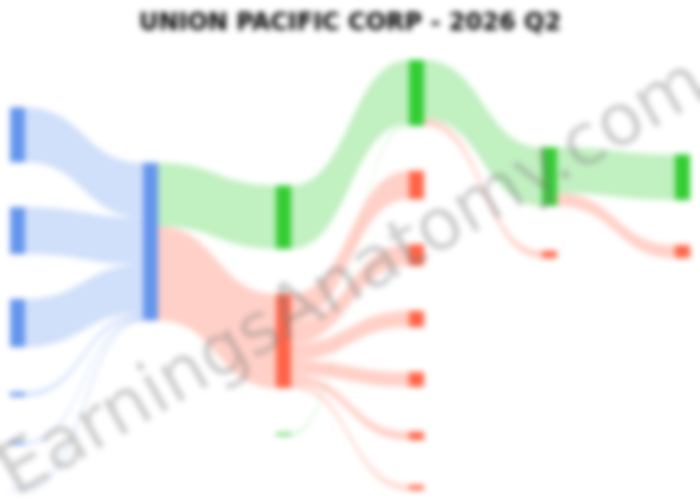
Union Pacific’s financial performance for the second quarter of 2026 paints a picture of robust demand offset by inflationary pressures on the cost side. For the three months ended June 30, 2026, total operating revenue hit $6.86 billion, representing a solid 12% increase from the $6.15 billion reported in Q2 2025.
This top-line growth was broad-based across all of Union Pacific’s major business segments. The Industrial division—moving chemicals, plastics, metals, and forest products—remained the largest revenue driver at $2.39 billion (up 8% year-over-year). Meanwhile, the Premium segment, which handles automotive and intermodal shipping (freight moved in containers seamlessly between trucks, trains, and ships), saw a massive 21% jump in revenue to $2.09 billion. Finally, the Bulk segment brought in $2.04 billion. Across the board, total revenue carloads ticked up by 2% to 2.16 million for the quarter, and the average revenue per car increased by 9% to $3,014.
But bringing in more revenue is only half the battle. On the expense side, operating costs jumped 13% to $4.10 billion. The primary culprit? A massive 63% spike in fuel costs, which surged to $938 million. According to the filing, locomotive diesel fuel prices averaged $3.86 per gallon in Q2 2026, up significantly from $2.42 per gallon a year earlier. This offset a commendable 1% improvement in the company's fuel consumption rate.
In the rail industry, analysts obsess over the operating ratio—a metric defined as operating expenses as a percentage of revenue, where a lower number indicates better efficiency. Because expenses grew slightly faster than revenues, Union Pacific's operating ratio crept up to 59.7%, compared to 59.0% in Q2 2025. Despite this margin pressure, the railroad still delivered a healthy bottom line. Net income grew to $1.99 billion (up from $1.88 billion), generating a basic and diluted Earnings Per Share (EPS) of $3.36.
Perhaps the most fascinating element of this filing isn't found in the daily operational metrics, but rather in the footnotes regarding capital allocation. Under Note 16, Union Pacific reports exactly zero share repurchases for the first half of 2026—a stark contrast to the nearly 11.9 million shares repurchased during the same period in 2025.
The company explicitly notes that it has paused its share repurchase program due to its pending acquisition of Norfolk Southern. Proposed in mid-2025 in a blockbuster deal with an enterprise value north of $80 billion, this merger aims to create the first single-line transcontinental railroad in U.S. history. If approved by the Surface Transportation Board (STB), the combined network would stretch from the Pacific Coast all the way to the Atlantic, fundamentally reshaping the North American supply chain and making rail an even more formidable competitor to long-haul trucking. The regulatory process is rigorous, and the suspension of buybacks illustrates how Union Pacific is conserving its capital and preparing its balance sheet for the industry's largest-ever consolidation.
Union Pacific’s Q2 2026 results show a company executing well on pricing and volume while battling the macro headwinds of higher diesel costs. Operating metrics are holding steady—freight car velocity is up 5% to 231 daily miles per car, and workforce productivity improved by 5%.
As the year progresses, all eyes will be on Washington D.C. and the STB regulators reviewing the Norfolk Southern merger. Until that massive domino falls, Union Pacific appears content to keep its head down, pass along higher costs where possible, and keep the American supply chain moving on schedule.
Last updated: July 28, 2026
Explore prior quarterly filings, historical revenue breakdowns, and earnings trends.
Union Pacific Q3 2026 Analysis: Pricing Power Drives Gains Amid Fuel Surges
Oct 22, 2026
Read
Union Pacific Q1 2026: Profit Growth and Norfolk Southern Acquisition
Apr 24, 2026
Read
Union Pacific 2025 10-K: Coal Resurgence and Merger Risks
Apr 3, 2026
Read
Union Pacific (UNP) Q3 2025 Earnings: A Deep Dive into the 10-Q Filing
Oct 24, 2025
Read