Loading blog posts...
July 24, 2026 • 4 min read
When diving into a company's income statement, the goal is to cut through the noise and see exactly how they are making—and spending—their money. A quick glance at the top-line numbers for Tesla might suggest business as usual, but if we unpack the numbers from their latest 10-Q filing, the second quarter of 2026 reveals a profound shift. The Austin-based electric vehicle (EV) pioneer is rapidly funneling its cash into artificial intelligence, robotics, and an unprecedented financial partnership with SpaceX.
Let's break down the actual numbers to see what’s driving Tesla's financials today.
Tesla's top line remains a powerhouse. Total revenue for Q2 2026 came in at a robust $28.2 billion, an impressive 26% leap from the $22.5 billion reported in Q2 of 2025.
The vast majority of this cash—$25.1 billion—still comes from the Automotive segment, which includes everything from vehicle sales to leasing and regulatory credits. However, their Energy generation and storage division continues to flex its muscles. Bringing in $3.1 billion, the energy segment actually outperformed the automotive side on profitability, boasting a juicy 20.4% gross margin compared to the auto segment's 16.4%.
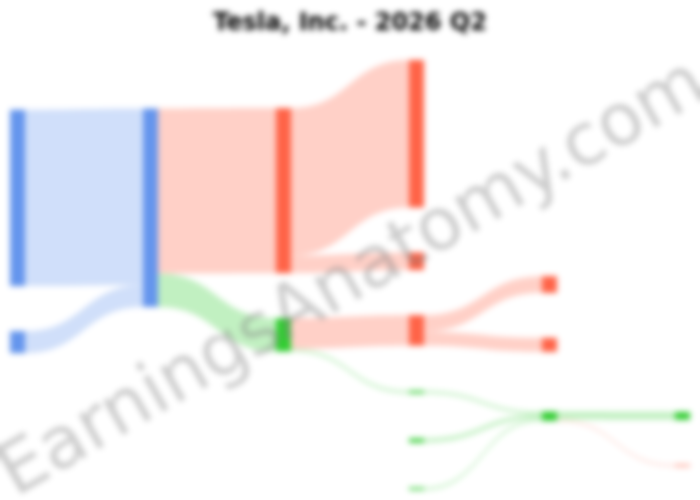
Here is a visual breakdown of how the revenue flows through the company's costs and expenses to generate profit for the quarter:
While revenue is surging, the profit derived directly from Tesla's core business operations took a massive hit. Operating income plummeted to just $398 million in Q2 2026—less than half of the $923 million reported in the same quarter last year. This translates to an incredibly thin operating margin of just 1.4%.
So, where did all the money go? The answer lies in heavy investments and aggressive compensation structures.
Operating expenses ballooned to nearly $4.4 billion for the quarter. Research and Development (R&D) alone consumed $2.4 billion, while Selling, General, and Administrative (SG&A) expenses ate up another $2.0 billion. A significant driver of these costs is stock-based compensation—a practice where a company pays executives and employees with equity options or restricted shares rather than cash. For the first six months of the year, this non-cash expense surged to nearly $2.2 billion, largely tied to new incentive plans like the "2025 CEO Performance Award" and a "2026 Implementation Agreement" intended to align leadership payouts with astronomical market capitalization milestones.
Alongside compensation, Tesla is spending heavily on the physical hardware needed for its autonomous ambitions. The balance sheet shows "AI infrastructure" jumping to $10.8 billion, contributing to a whopping $8.3 billion in total capital expenditures for the first half of the year.
If operating income was so low, how did Tesla still post a healthy net income of $1.1 billion for the quarter?
The cash flow statement holds the secret: a massive $1.0 billion unrealized gain on a private equity investment in SpaceX. An unrealized gain is essentially a "paper profit"; it means the estimated market value of an asset has increased, but the company hasn't actually sold it to lock in the cash.
Earlier this year, Tesla poured $2.0 billion into SpaceX. Recent comments from Elon Musk confirm that the two companies are experiencing growing strategic overlap. A major reason for this massive capital crossover is a joint initiative known as Terafab—a semiconductor manufacturing project designed to produce the next-generation AI chips required to power "Optimus," Tesla's humanoid robot, as well as its upcoming automated Cybercab network.
Tesla is officially operating on two parallel tracks. On one side, it remains a dominant EV and battery manufacturer generating over $28 billion in quarterly revenue. On the other, it is behaving like an aggressive tech incubator—pouring billions into AI compute clusters, robotics hardware, and literal rocket companies to secure its long-term vision.
While the traditional automotive market remains highly competitive—facing fierce pricing pressure from Chinese giants like BYD and legacy automakers pivoting to EVs—Tesla’s balance sheet shows a company that is already betting its massive cash flow on an entirely automated, AI-driven future.
Last updated: July 24, 2026
Explore prior quarterly filings, historical revenue breakdowns, and earnings trends.
Tesla Q3 2026 10-Q Analysis: Gross Margins Expand While R&D Surge Squeezes Profits
Oct 22, 2026
Read
Tesla Q1 2026 Earnings: Auto Profits Fuel AI and SpaceX Ambitions
Apr 23, 2026
Read
Tesla 2025 10-K: Energy Margins Beat Auto Amid AI Pivot
Jan 29, 2026
Read
Tesla Q3 2025 10-Q: Profits Fall 37% Despite Revenue Growth on R&D Surge
Oct 23, 2025
Read