Loading blog posts...
July 29, 2026 • 4 min read
The goal here is to dig into Teledyne Technologies’ income statement and see what the latest quarter says about the business: where growth is coming from, how much of it is turning into profit, and what costs are moving under the surface. Teledyne is a diversified technology company best known for digital imaging, sensors, instrumentation, aerospace and defense electronics, and engineered systems. Its products show up in markets ranging from factory automation and medical/scientific imaging to marine monitoring, satellites, and defense platforms.
Teledyne’s latest 10-Q filing for the quarter ended June 28, 2026 shows a strong quarter: net sales rose 9.8% year over year to $1.66 billion, while net income attributable to Teledyne increased 19.9% to $251.7 million. Diluted EPS climbed to $5.37, up from $4.43 a year earlier. Recent company commentary also described the quarter as a record period for orders, sales, and operating profit, helped by defense demand and strength in digital imaging.
Teledyne’s second-quarter gross profit was $738.1 million, producing a 44.4% gross margin, up from roughly 42.6% last year. That improvement matters: sales grew 9.8%, but cost of sales rose only 6.4%, meaning more incremental revenue flowed through to profit.
Operating income increased 19.8% to $333.2 million, and operating margin expanded to 20.0% from about 18.4% a year ago. That is a meaningful profitability step-up for a company with hardware-heavy businesses, where manufacturing cost, mix, and R&D spending can all pressure margins.
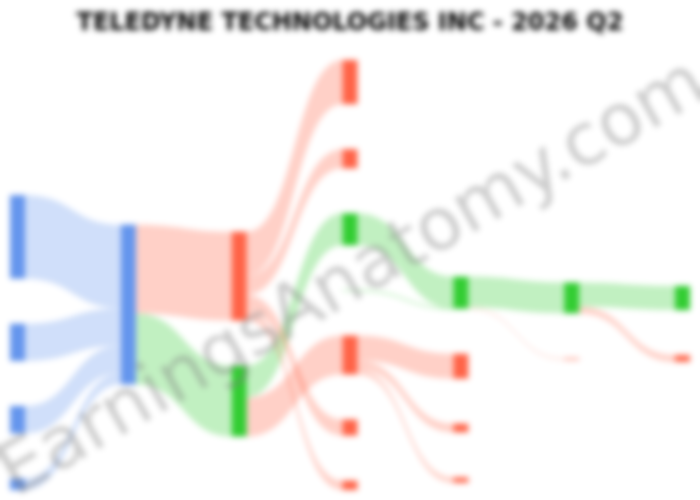
Here is the quarterly income statement flow from revenue to net income:
Operating expenses totaled $404.9 million, led by SG&A of $258.7 million, R&D of $90.2 million, and acquired intangible amortization of $56.0 million. R&D rose 9.5%, largely due to Digital Imaging, suggesting Teledyne is still investing behind core technology platforms rather than simply harvesting margin.
The standout segment was Digital Imaging, Teledyne’s largest business, which includes imaging sensors, cameras, infrared/thermal systems, and machine-vision technologies. Sales rose 12.7% to $868.7 million, or about 52% of total company revenue. Even more important, segment operating income jumped 42.3% to $170.2 million, and margin expanded to 19.6% from 15.5%.
That margin expansion was the biggest driver of Teledyne’s overall profit improvement. Digital Imaging’s cost of sales fell as a percentage of revenue, even as R&D increased nearly 20%, indicating a favorable sales mix and better operating leverage.
The other segments were more mixed:
Teledyne reported $421.9 million of second-quarter sales to the U.S. government, including prime contractor and subcontractor sales. That was about 25% of total revenue. The filing notes that the company continues to benefit from increased global defense spending, which is visible in Aerospace and Defense Electronics and parts of Digital Imaging and Engineered Systems.
Geographically, the U.S. remained the largest destination market at $844.4 million, followed by Europe at $450.5 million, Asia at $223.0 million, and all other regions at $144.6 million.
For the first six months of 2026, operating cash flow was $549.2 million, up from $469.2 million a year earlier. Teledyne also repaid $450 million of 1.60% senior notes due April 2026, reducing total debt from $2.48 billion at year-end to $2.03 billion.
One working-capital item worth watching: inventories increased to $1.17 billion from $1.04 billion at year-end, including a notable rise in raw materials and supplies. Inventory growth can support future demand, but it also ties up cash if sales growth slows.
Teledyne’s Q2 filing shows a business growing faster at the profit line than at the sales line. The strongest signal is Digital Imaging, where revenue growth, margin expansion, and continued R&D investment are all moving in the right direction. Defense demand is another clear support, while Instrumentation’s mix pressure is the main blemish.
In a market that includes diversified industrial-tech and defense electronics players such as AMETEK, Keysight, L3Harris, and RTX suppliers, Teledyne’s edge remains its specialized sensor and imaging portfolio. This quarter’s income statement suggests that portfolio is converting demand into higher margins — a key metric to watch in future filings.
Last updated: July 29, 2026