Loading blog posts...
July 28, 2026 • 4 min read
If you've ever leaned into an engine bay with a socket wrench in hand, chances are you've held a Snap-on tool. The Kenosha, Wisconsin company is the premium brand for professional mechanics—selling wrenches, diagnostics, and shop equipment through a distinctive network of franchised vans that roll right up to repair shops. It's an unusual, sticky business model, and it just delivered a second-quarter that shows both its resilience and its pressure points. Let's dig into the numbers from Snap-on's latest 10-Q filing to see how the tool-maker is actually doing.
For the quarter ended July 4, 2026, Snap-on posted total revenue of $1.33 billion, up from $1.28 billion a year earlier. Net earnings came in at $266.2 million, translating to $4.96 in diluted earnings per share—up from $4.72 last year. That's a solid, if unspectacular, 4%-plus advance on both the top and bottom lines.
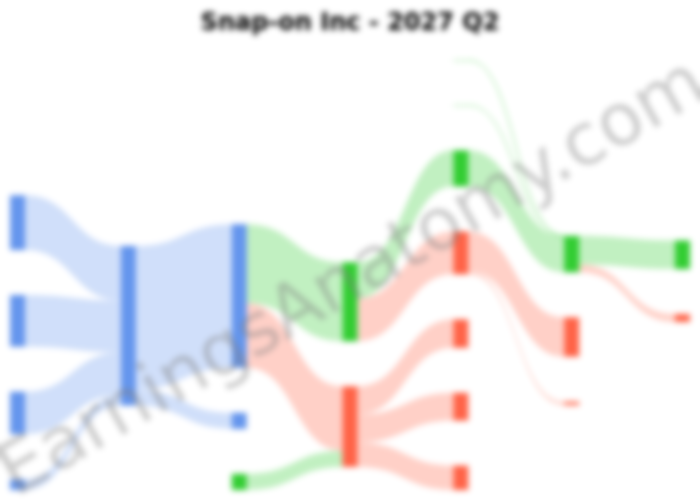
Here's how the quarter's revenue flowed through to profit:
A quick note on the flow diagram: the "gross" revenue of roughly $1.5 billion includes $149.8 million of intersegment eliminations—internal sales between Snap-on's own divisions (for example, the Commercial & Industrial group selling to Repair Systems) that get netted out so the company doesn't double-count. Once removed, you land at the reported $1.33 billion.
The margin story is encouraging. Gross margin came in at 55.1%, and operating margin at 25.2%. Cost of goods sold actually shrank as a percentage of sales versus last year, reflecting benefits from the company's "RCI" (Rapid Continuous Improvement) manufacturing initiatives.
Snap-on reports four business segments, and they moved in notably different directions this quarter.
Snap-on Tools Group ($508.8M revenue, the largest at ~38% of the total) is the iconic franchise-van business selling directly to mechanics. It grew a modest 3.6%, but operating margin slipped from 23.8% to 22.6% on higher personnel and freight costs. This division reflects the health of the individual technician—who buys big-ticket tools on credit—and management has flagged softer activity there.
Commercial & Industrial Group ($395.8M) was the standout, with segment operating earnings jumping 41.8% to $66.5 million as margins expanded 260 basis points. This division serves industrial customers, government, aviation, and specialty markets—less dependent on the individual mechanic's wallet.
Repair Systems & Information Group ($480.3M) sells diagnostics, undercar equipment, and repair-data software to shop owners. Revenue edged up 2.5%, but operating margin fell from 25.6% to 24.0% amid heavier technology investment. Notably, this segment is being fed by acquisitions—Snap-on's recent $100 million Diesel Laptops deal expanded its heavy-duty truck diagnostics footprint.
Financial Services ($99.7M) is essentially Snap-on's in-house lender, financing tool purchases for franchisees and customers. Operating earnings dipped slightly to $67.5 million.
The pattern is telling: the more the segment leans on the individual, credit-buying technician, the softer the growth. The industrial and information-driven businesses are carrying the quarter.
Snap-on remains a shareholder-friendly compounder. It raised its dividend to $2.44 per share (from $2.14), repurchased 241,000 shares for $91.4 million, and still sits on $1.64 billion in cash. Goodwill climbed to $1.23 billion, up over $120 million from acquisitions during the first half—confirming that the company is deploying capital into deals like Diesel Laptops to bolster its higher-margin software and diagnostics arm.
One item worth watching: $300 million in notes due 2027 moved into current liabilities, which is why current maturities of long-term debt jumped from $16 million to $317 million. With cash comfortably exceeding that, it's a manageable refinancing question rather than a concern.
Snap-on delivered a dependable quarter—growing earnings, expanding gross margins, and rewarding shareholders. But beneath the steady headline lies a real divergence: strength in industrial and diagnostics offset by a cautious professional-technician base whose willingness to finance big purchases is under some strain. In a fragmented tools-and-equipment market where Snap-on competes with the likes of Stanley Black & Decker (Mac Tools), Matco, and Bosch on diagnostics, its franchise-van moat and financing arm remain powerful differentiators. The challenge ahead is reigniting the individual-mechanic demand that built the brand, while its bets on repair software and heavy-duty diagnostics increasingly become the growth engine.
Last updated: July 28, 2026
Explore prior quarterly filings, historical revenue breakdowns, and earnings trends.