Loading blog posts...
October 23, 2026 • 3 min read
Selective Insurance earned more on less revenue in the third quarter of 2026. A closer look at its latest 10-Q helps explain why—and separates improvements in insurance profitability from investment effects. Selective is a U.S. property-and-casualty insurer covering businesses, households, and specialized risks through its excess and surplus (E&S) operations.
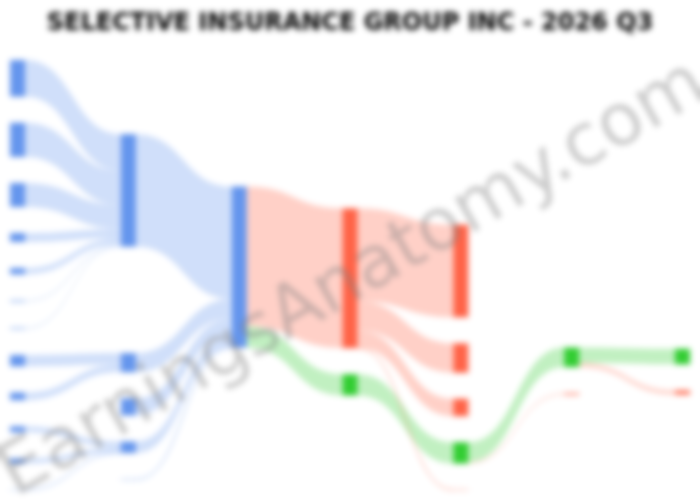
Net income increased 11.5% to $128.7 million, despite a 2.5% revenue decline to $1.33 billion. Diluted earnings per share rose to $2.11 from $1.85, helped by a lower average share count.
The flow below traces the quarter’s revenues through expenses to net income.
Underwriting income—profit from insurance operations before investment results, interest, and corporate expenses—more than doubled to $37.4 million from $16.7 million. The combined ratio improved to 96.8% from 98.6%. This measures claims and underwriting costs against earned premiums; below 100% means underwriting profitability.
Claims and loss expenses declined 6.9% to $762.7 million, even as net catastrophe losses climbed to $64.1 million from $24.9 million.
The comparison needs context. Last year’s quarter included $40 million of adverse prior-year casualty reserve development: increases in estimated costs for older claims. No such development occurred this quarter. Removing that prior-year burden improved the loss-ratio comparison by 3.3 percentage points, offsetting the 3.3-point deterioration from catastrophe losses.
Results remained uneven:
Net investment income rose 15.7% to $160.5 million, with fixed-income income contributing most of the increase. Management raised full-year after-tax net investment income guidance to $490 million from $480 million.
However, $19.4 million in realized and unrealized investment losses, versus an $8.1 million gain last year, reduced that benefit. Equity valuation losses and fixed-income credit-loss provisions were the principal negative components.
A larger hit occurred outside net income. Investment valuation changes drove most of a $266.7 million other comprehensive loss, producing a $138.1 million comprehensive loss for the quarter. Other comprehensive income captures certain changes recorded directly in equity rather than current earnings. Thus, stronger reported profits did not prevent portfolio marks from weakening book equity.
Net premiums written fell 7% to $1.12 billion, while renewal price increases slowed to 5.6% from 9.6%. Written premiums reflect policies sold or renewed; earned premiums recognize that business over its coverage period.
This distinction matters: falling written premiums can precede pressure on earned revenue. Meanwhile, the underwriting expense ratio increased to 32.1% from 30.6%, and management explicitly linked commercial-lines expense pressure to lower earned premiums.
Selective’s quarter shows better underwriting profitability and stronger investment income, but not broad-based strength. In a market shared with larger insurers such as Travelers and The Hartford, the key challenge is preserving pricing discipline and controlling costs while repairing loss-making liability and auto business—not simply restoring premium growth.
Last updated: October 23, 2026
Explore prior quarterly filings, historical revenue breakdowns, and earnings trends.